NAVYPEDIA
 Support the project with paypal
 HOME
HOME FIGHTING SHIPS OF THE WORLD
 UNITED STATES OF AMERICA
 SUBMARINES
 V4 submarine (1928)
Photo
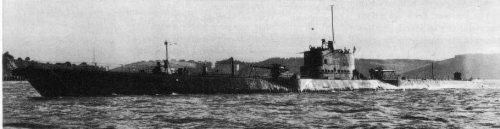
Argonaut 1942
Ships
| No | Name | Yard No | Builder | Laid down | Launched | Comm | Fate |
|---|---|---|---|---|---|---|---|
| SF7, 2.1931- SM1, 7.1931- SS166, 9.1942- APS1 | V4, 2.1931- Argonaut | Portsmouth N Yd | 5.1925 | 10.11.1927 | 4.1928 | cargo submarine 9.1942, sunk 10.1.1943 |
Technical data
| Displacement standard, t | |
|---|---|
| Displacement normal, t | 2878 / 4045 |
| Length, m | 109.7 wl 116.1 oa |
| Breadth, m | 10.3 |
| Draught, m | 4.88 |
| No of shafts | 2 |
| Machinery | 2 MAN diesels + 2 MAN diesel-generators / 2 electric motors |
| Power, h. p. | 3175 / 2200 |
| Max speed, kts | 13.65 / 7.4 |
| Fuel, t | diesel oil 696 |
| Endurance, nm(kts) | 18000 (10) / 50 (5) |
| Armament | 2 x 1 - 152/53 Mk 12.14, 2 x 1 - 7.6/90, 4 - 533 TT (8, bow), 60 mines |
| Electronic equipment | SC sonar |
| Complement | 86 |
| Diving depth operational, m | 95 |
Standard scale images

Argonaut 1942
Graphics
Argonaut 1942
Project history
Unique USN purpose-built minelaying submarine. Naval management offered to raise displacement for providing necessary in conditions of Pacific theatre endurance, and in some cases it wore enough absurd character: so, "monster" figured in one of sketch design with 20500t displacement. Finally Bureau of construction has prepared in 1922 basic design with surface displacement hardly more than 2500t, armed by two 152/53mm guns of cruiser calibre, four bow TTs and two mine tubes in a stern for 60 mines, should make self-sufficiency of 90 days, and an endurance at a full fuel stowage 18000nm. The hull of future Argonaut has been calculated for a diving depth of 95m instead of 60m at previous classes. At designing, besides usage of some technical decisions applied on S and Barracuda classes submarines, Americans have probably full considered the German experience of building of submarine cruisers in days of the First World War. In particular, on early design stages a fore end was planed to fulfil with characteristic bulb-shape stem as on Barracuda, but in final variant the characteristic sharp "German" bow figured.
Double-hulled, machinery was of combined type (main diesels directly connected with shafts and auxiliary diesel-generators for recharging batteries). To advantages of this submarine it is possible to refer, perhaps, only endurance and good conditions of habitability (that, however, for three-monthly voyage is important). In remaining submarine was mediocre enough: she had bad manoeuvrabiliy and slow speed.
Modernizations
1930s: + JK sonar
1940: diesels were replaced by more powerful Fairbank-Morse (6000 h. p., 15 kts surfaced); - SC sonar: + QCD sonar
9/1942, Argonaut was converted to cargo submarine, mine deck and spare torpedoes compartment were rebuilt as cargo holds; + SD, SJ radars
Naval service
10.1.1943 Argonaut was sunk by Japanese destroyers Isokaze and Maikaze between Bougainville and New Britannia.