NAVYPEDIA
 Support the project with paypal
 HOME
HOME FIGHTING SHIPS OF THE WORLD
 UNITED STATES OF AMERICA
 TORPEDO SHIPS
 PORTER destroyer leaders (1936 - 1937)
Photo
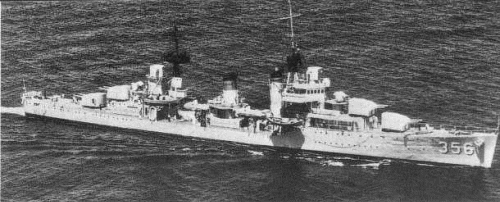
Porter 1938
Ships
| No | Name | Yard No | Builder | Laid down | Launched | Comm | Fate |
|---|---|---|---|---|---|---|---|
| DD356 | Porter | 408 | New York SB, Camden | 12/1933 | 12.12.1935 | 8/1936 | sunk 26.10.1942 |
| DD357 | Selfridge | 409 | New York SB, Camden | 12/1933 | 18.4.1936 | 11/1936 | stricken 11.1945 |
| DD358 | McDougal | 410 | New York SB, Camden | 12/1933 | 17.7.1936 | 12/1936 | miscellaneous auxiliary AG126 9.1945 |
| DD359 | Winslow | 411 | New York SB, Camden | 12/1933 | 21.9.1936 | 2/1937 | miscellaneous auxiliary AG127 9.1945 |
| DD360 | Phelps | 1451 | Bethlehem, Quincy | 1/1934 | 18.7.1935 | 2/1936 | stricken 1.1947 |
| DD361 | Clark | 1452 | Bethlehem, Quincy | 1/1934 | 15.10.1935 | 5/1936 | stricken 11.1945 |
| DD362 | Moffett | 1453 | Bethlehem, Quincy | 1/1934 | 11.12.1935 | 8/1936 | stricken 1.1947 |
| DD363 | Balch | 1454 | Bethlehem, Quincy | 5/1934 | 24.3.1936 | 10/1936 | stricken 11.1945 |
Technical data
| Displacement standard, t | 1834 |
|---|---|
| Displacement full, t | 2597 |
| Length, m | 113.4 wl 116.2 oa |
| Breadth, m | 11.3 |
| Draught, m | 3.96 full load |
| No of shafts | 2 |
| Machinery | 2 sets geared steam turbines, 4 Babcock & Wilcox boilers |
| Power, h. p. | 50000 |
| Max speed, kts | 37 |
| Fuel, t | oil 635 |
| Endurance, nm(kts) | 6500 (12) |
| Armament | 4 x 2 - 127/38 Mk 12, 2 x 4 - 28/75 Mk 1, 2 x 1 - 12.7/90, 2 x 4 - 533 TT (16), 2 DCR (14) |
| Electronic equipment | QCA sonar |
| Complement | 194 |
Standard scale images
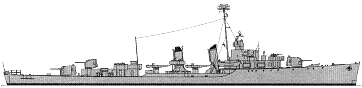
Phelps 1944
Graphics
Porter 1938
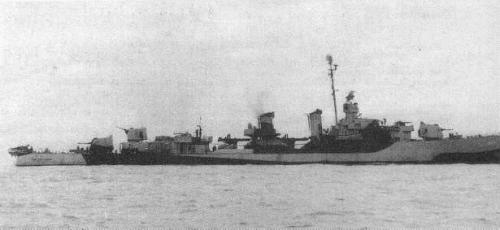
Selfridge 1944
Project history
Ships of Porter class became the first USN destroyer leaders. Necessity in similar ships has been realised by the General Board in 1917 when along with a building of the big number of 'flushdeckers' designing of the ship, called to fulfil a role of flotilla leader was begun: larger, than destroyer, and carrying more powerful artillery. FY1921 programme provided the building of five similar ships (2200t, 35kts, 5 127mm guns, 4 triple TTs), but Congress has not outlined necessary means, giving so reason that there were a lot of destroyers in the US Navy at war end. Designing of leaders with displacement from 1600 to 2900t was started again only in the late twenties.
In 1930 the London Naval conference has established a maximal 1850t standard displacement for leaders, and the General Board earlier declined in favour of the ship with moderate dimensions, decided to raise displacement of future leaders to the resolved limit. Growth of the dimensions was supposed to expend to better seaworthiness, additional equipment, necessary for a command ship, and improvement of habitation conditions. For November, 1930 Bureau of Construction has prepared a sketch design of new ship. At 1850t standard displacement armament consisted from 4 single 127/25mm DP guns and 2 quadruple TTs, speed reached 35.5kts. Application of light armour (12.7mm thickness) of machinery and bridge became the important innovation.
Though the design as a whole satisfied the General Board, works over leader for some reasons were delayed: in particular, not a small role was played by appearance of new 127/38mm DP gun, that has demanded significant processing of the design. Again it has been submitted to considering in January, 1932, and the number of 127/38mm DP guns has increased to five (two months later, at design correction, the sixth was added). In the mid of the same year when it seemed, that all possible remarks are considered, the Bureau of Construction was able to insist on replacement of DP main guns by SP twin mounts, that allowed to raise gun number to eight. As compensation 2 quadruple 28mm AA MGs were provided.
Abandoning from DP main guns in early 1930th was presented not too much effort for two additional main guns, and in this variant armament structure have been approved by the General Board. Artillery replacement has allowed to make one more change to armament structure: to place around aft funnel storehouse for eight spare torpedoes that outlined Porter class among remaining American destroyers. Machinery arrangement of new leaders essentially did not differ from Farragut class, only turbines were positioned in separate rooms.
All eight ships of this class were built under the FY1933 program. The detailed design was fulfilled by New York Shipbuilding Co.
Modernizations
mid-1941 - early 1942, all: - 2 x 1 - 12.7/90, spare torpedoes; + 3 x 1 - 20/70 Mk 4
1942-1943, almost all survived: + SC, SG, Mk 3 radars
10 - 12.1943, all survived: - 2 x 4 - 28/75; + 3 x 2 - 40/56 Mk 1.2, 3 x 1 - 20/70 Mk 4
3/1943 - 3.1944, McDougal, Winslow, Phelps, Clark, Moffett, Balch: - 1 x 2 - 127/38 (No 3); + 1 x 4 - 40/56 Mk 1.2, 4 DCT (in total 48 DC)
late 1944 - early 1945, Selfridge: - 4 x 2 - 127/38, 1 x 2 - 40/56, Mk 3 radar; + 2 x 2 - 127/38 Mk 12 (DP), 1 x 1 - 127/38 Mk 12 (DP), 1 x 4 - 40/56 Mk 1.2, 4 DCT (in total 48 DC), Mk 12.22 radar
late 1944 - early 1945, McDougal, Winslow, Phelps: - 3 x 2 - 127/38, Mk 3 radar, 1 x 2 - 40/56; + 2 x 2 - 127/38 Mk 12 (DP), 1 x 1 - 127/38 Mk 12 (DP), Mk 12.22 radar
8/1945, Selfridge, Winslow, Phelps: - 6 x 1 - 20/70, 2 x 4 - 533 TT, 2 DCT, 1 DCR (22 DC in total); + 2 x 4 - 40/56 Mk 1.2, 2 x 2 - 20/70 Mk 4, displacement was increased to 2154/2857t.
1/1946, DD360: 2 x 2 - 127/38 Mk 38, 1 x 1 - 127/38 Mk 30, 3 x 4 - 40/60 Mk 2, 2 x 2 - 40/60 Mk 1, 2 x 2 - 20/70 Mk 24, 2 DCT, 1 DCR (22), SC, SG, Mk 12.22 radars, QCA sonar
1/1946, DD362: 3 x 2 - 127/38 Mk 22, 1 x 4 - 40/60 Mk 2, 3 x 2 - 40/60 Mk 1, 6 x 1 - 20/70 Mk 10, 2 x 4 - 533 TT, 4 DCT, 2 DCR (48), SC, SG, Mk 3 radars, QCA sonar