NAVYPEDIA
 Support the project with paypal
 HOME
HOME FIGHTING SHIPS OF THE WORLD
 UNITED STATES OF AMERICA
 TORPEDO SHIPS
 CALDWELL destroyers (1917 - 1920)
Photo
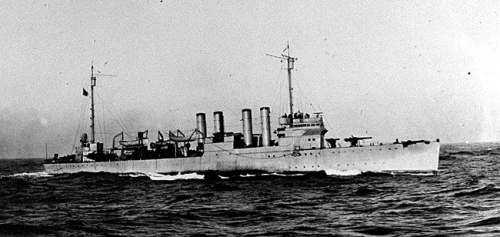
Caldwell 1918
Ships
| No | Name | Yard No | Builder | Laid down | Launched | Comm | Fate |
|---|---|---|---|---|---|---|---|
| DD69 | Caldwell | Mare Island N Yd, Vallejo | 12.1916 | 10.7.1917 | 12.1917 | stricken 1.1936 | |
| DD70 | Craven, 11.1939- Conway | Norfolk N Yd, Portsmouth | 11.1917 | 29.6.1918 | 10.1918 | to United Kingdom 10.1940 (Lewes) | |
| DD71 | Gwin | 87 | Todd, Tacoma | 6.1917 | 22.12.1917 | 3.1920 | stricken 1.1937 |
| DD72 | Conner | 436 | Cramp, Philadelphia | 10.1916 | 21.8.1917 | 1.1918 | to United Kingdom 10.1940 (Leeds) |
| DD73 | Stockton | 437 | Cramp, Philadelphia | 10.1916 | 17.7.1917 | 11.1917 | to United Kingdom 10.1940 (Ludlow) |
| DD74, 11.1938- AG28, 8.1940- APD1, 6.1945- DD74 | Manley | 70 | Bath Iron Wks | 8.1916 | 23.8.1917 | 10.1917 | auxiliary 11.1938, fast amphibious transport 8.1940, destroyer 6.1945, stricken 12.1945 |
Technical data
| Data variant | as commissioned | APD conversion |
|---|---|---|
| Displacement standard, t | 1120 |
1315 |
| Displacement full, t | 1187 |
1793 |
| Length, m | 94.5 wl 96.2 oa |
96.2 |
| Breadth, m | 9.30 |
9.30 |
| Draught, m | 2.70 |
3.76 |
| No of shafts | DD69 - 71, 74: 2 DD72, 73: 3 |
2 |
| Machinery | DD69: 2 sets Curtis geared steam turbines, 4 Thornycroft boilers DD70, 71: 2 sets Parsons geared steam turbines, 4 Thornycroft boilers DD72, 73: 3 Curtis steam turbines / 1 geared steam turbine for cruising, 4 Yarrow boilers DD74: 2 sets Parsons geared steam turbines, 4 Normand boilers |
2 sets Parsons geared steam turbines, 2 Normand boilers |
| Power, h. p. | 18500 |
13000 |
| Max speed, kts | 30 |
22 - 24 |
| Fuel, t | oil 310 |
oil 429 |
| Endurance, nm(kts) | 2500(20) | |
| Armament | DD69, 72 - 74: 4 x 1 - 102/50 Mk IX, 2 x 1 - 37/43 Mk VI/VII, 4 x 3 - 533 TT, 2 DCR DD70, 71: 4 x 1 - 102/50 Mk IX, 2 x 1 - 37/43 Mk VI/VII, 4 x 3 - 533 TT, 1 DCT, 2 DCR |
3 x 1 - 102/50 Mk 9, 4 x 1 - 12.7/90, 4 DCT, 2 DCR |
| Military load | --- | 4 LCP(L) or LCP(R), 120 troops |
| Electronic equipment | --- | QCJ sonar |
| Complement | 100 |
101 |
Graphics
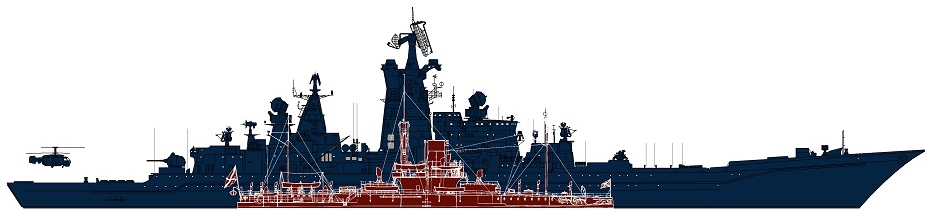
Caldwell 1918
Project history
The first of the famous 'flush deckers', these ships were intermediate between the 'thousand tonners' and the mass-production destroyers of World War One. Their characteristics essentially duplicated those of the earlier ships, but C&R proposed a new flush-deck hull form, to reduce rolling and pitching. Beam and midship cross-section both increased slightly, and draft had to be reduced in compensation. That in turn would have reduced hull depth (hence strength) in a conventional broken-forecastle hull; C&R solved the problem by increasing freeboard amidships, so that hull scantlings (hence weight) could beheld down. The designers hoped that dryness could be preserved, since the bow freeboard of earlier ships was retained. In practice, however, the flush-deckers were far wetter than their predecessors. Shallow draft also meant that the propellers would not be deep enough, and the ships had to be designed with a drag, ie with a keel sloping aft.
Steam Engineering proposed a new triple-screw power-plant, the centre shaft being driven by the high-pressure turbine, with a geared cruising turbine clutched to it. The sketch design also showed three rather than four funnels, the two inner ones being trunked together. In practice, however, only the two Cramp ships followed the original design. The other four had twin screws (with Curtis geared turbines in DD 69, Parsons geared turbines in the others). Only the two Cramp ships and the Gwin had triple funnels. Unlike the mass-production 'flush-deckers', these ships had cutaway (vice cruiser) sterns.
Modernizations
1918, all: - 2 x 1 - 37/43; + 2 x 1 - 76/23 Mk XIV
1918, Caldwell, Conner, Stockton, Manley: + 1 DCT
1930s, all survived: - 1 x 1 - 76/23; + 2 x 1 - 12.7/90
(11/1938-2/1939, New York N Yd), Manley was converted to fast transport with data as given in the table.
1942 - mid-1944, Manley: - 4 x 1 - 102/50, 4 x 1 - 12.7/90; + 3 x 1 - 76/50 Mk 20, 1 x 2 - 40/56 Mk 1.2, 5 x 1 - 20/70 Mk 4, presumably SA, SE radars
Naval service
Single ship formally participated in WWI operations, was Conner, based at Brest in June, 1918.