NAVYPEDIA
 Support the project with paypal
 HOME
HOME FIGHTING SHIPS OF THE WORLD
 UNITED STATES OF AMERICA
 AIRCRAFT CARRYING SHIPS
 YORKTOWN aircraft carriers (1937 - 1941)
Photo
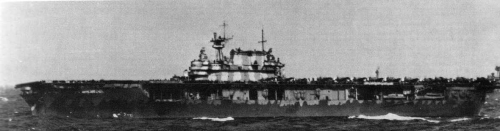
Hornet 1942
Ships
| No | Name | Yard No | Builder | Laid down | Launched | Comm | Fate |
|---|---|---|---|---|---|---|---|
| CV5 | Yorktown | 359 | Newport News | 21.5.1934 | 4.4.1936 | 30.9.1937 | sunk 7.6.1942 |
| CV6, 10.1952- CVA6, 8.1953- CVS6 | Enterprise | 360 | Newport News | 16.7.1934 | 3.10.1936 | 12.5.1938 | stricken 10.1956 |
| CV8 | Hornet | 385 | Newport News | 25.9.1939 | 14.12.1940 | 20.10.1941 | sunk 24.10.1942 |
Technical data
| Displacement standard, t | 19875 |
|---|---|
| Displacement full, t | 25484 |
| Length, m | 234.7 wl 246.6 oa 251.4 max by flight deck |
| Breadth, m | 25.3 wl 33.4 oa |
| Draught, m | 7.90 full load |
| No of shafts | 4 |
| Machinery | 4 sets Westinghouse geared steam turbines, 9 Babcock & Wilcox boilers |
| Power, h. p. | 120000 |
| Max speed, kts | 32.5 |
| Fuel, t | oil 2754 - 4360 |
| Endurance, nm(kts) | 12000 (15) |
| Armour, mm | belt: 102 - 64 on 19mm plating, deck 38, bulkheads 102, CT: 102 sides, 51 roof |
| Armament | CV5: 8 x 1 - 127/38 Mk 12, 4 x 4 - 28/75 Mk 1, 24 x 1 - 12.7/90, 96 aircraft (F4B, F2F, F3F fighters, F11C, BFC, BF2C Goshawk fighters - dive bombers, BG, SBU, SBC Helldiver dive bombers, BM dive / torpedo bombers, TBD Devastator torpedo bombers, T4M, TG torpedo bombers - reconnaissance planes, O3U, SU, SOC Seagull reconnaissance planes) CV6: 8 x 1 - 127/38 Mk 12, 4 x 4 - 28/75 Mk 1, 24 x 1 - 12.7/90, 96 aircraft (F2F, F3F fighters, F11C, BFC, BF2C Goshawk fighters - dive bombers, BG, SBU, SBC Helldiver, SB2U Vindicator, BT dive bombers, BM dive / torpedo bombers, TBD Devastator torpedo bombers, O3U, SU, SOC Seagull reconnaissance planes) CV8: 8 x 1 - 127/38 Mk 12, 4 x 4 - 28/75 Mk 1, 24 x 1 - 12.7/90, 96 aircraft (F2A Buffalo, F4F Wildcat fighters, SBC Helldiver, SB2U Vindicator, SBD Dauntless dive bombers, TBD Devastator torpedo bombers, SOC Seagull reconnaissance planes) |
| Electronic equipment | CV8: SC radar |
| Complement | 2175 (1942) |
Air group
| Year | Fighters | dive bombers | torpedo bombers | Reconnaissance |
|---|---|---|---|---|
| 6.1938 (Enterprise) | 20 F3F | 21 SBC Helldiver, 13 BT | 20 TBD Devastator | 2 O3U |
| 6.1942 (Yorktown) | 25 F4F Wildcat | 37 SBD Dauntless | 13 TBD Devastator | --- |
| 6.1942 (Enterprise) | 27 F4F Wildcat | 37 SBD Dauntless | 14 TBD Devastator | --- |
| 6.1942 (Hornet) | 27 F4F Wildcat | 37 SBD Dauntless | 15 TBD Devastator | --- |
| 6.1944 (Enterprise) | 31 F6F Hellcat, 3 F4U Corsair | 23 SBD Dauntless | 15 TBF Avenger | --- |
Standard scale images
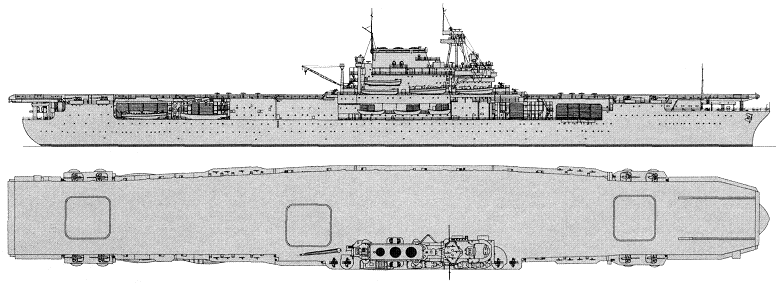
Yorktown 1941
Graphics
Hornet 1942
Aircraft facilities
(fd - 6,835 m², ha - 3,194 m² / 16,773 m³): Flight deck: 244.6 x 29.9 m (248.3x29.9m on CV8). Hangar: 166.4 x 19.2 x 5.25 m. There were 3 elevators (14.6 x 13.7 m, 7.7 t) and 3 H II catapults (2 on flight deck and 1 doubled athwartship catapult in the hangar). Aircraft fuel stowage: 673 900 l.
Project history
After order of Ranger remaining USN aircraft carriers, according to the Washington Treaty, could had 55000t summary displacement. In this limit it was possible to built three 18500t ships or two 27000t. Naval staff would prefer to have three carriers, but as it has shown by world experience, limited dimensions of carriers sharply reduced their battle capabilities. Eventually they came to the compromise variant: it has been decided to built two 20700t ships and one more smaller (future CV7 Wasp). CV5 and 6 have been laid down in 1934; four years later, after cancellation of Washington Treaty, Congress decided to build the third ship of class, CV8.
Yorktown design appeared much more successfully than predecessor (Ranger), harmoniously combining offensive and defensive abilities. The hangar was designed for huge air group (96 planes at the moment of designing, subsequently because of the increased sizes of planes their number was decreased). Besides two catapults on a flight deck there was third one a deck below: with its help it was possible to launch planes directly from hangar through special ports. Besides, original idea has not justified, and third catapult was removed in 1942. Carriers had quite good armour protection similar 'Washington' cruisers. Unlike Ranger, Yorktown received underwater protection. However, this protection can resist from explosion of torpedo with 180kg TNT warhead, while battleships were capable to sustain explosion of 320kg TNT.
Ship protection
There was 102-64mm armoured belt, connected with 38mm armoured main deck and closed by 102mm transverse bulkheads. CT had 102mm sides and 51mm roof.
Modernizations
1940, Yorktown: + CXAM radar
1940, Enterprise: + CXAM-1 radar
mid-1942, Yorktown, Hornet: - 24 x 1 - 12.7/90; + 24 x 1 - 20/70 Mk 4, 2x Mk 4 radars
mid-1942, Enterprise: - 24 x 1 - 12.7/90; + 32 x 1 - 20/70 Mk 4, 2x Mk 4 radars
8/1942, Enterprise: + 1 x 4 - 28/75 Mk 1, 6 x 1 - 20/70 Mk 4, SC-2 radar
8/1942, Hornet: + 1 x 4 - 28/75 Mk 1, 8 x 1 - 20/70 Mk 4
11/1942, Enterprise: - 4 x 1 - 28/75; + 4 x 4 - 40/56 Mk 1.2, 8 x 1 - 20/70 Mk 4
10/1943, Enterprise: bulges were fitted, breadth by wl increased to 29.1m, displacement to 24128/29882t and fuel stowage to 6511t. - 1 x 4 - 28/75, CXAM-1, 2x Mk 4 radars; + 2 x 4 - 40/56 Mk 1.2, 8 x 2 - 40/56 Mk 1.2, 1 x 3 - 20/70 Mk 4, 1 x 2 - 20/70 Mk 4, 2 x 1 - 20/70 Mk 4, SK, SM, 2x Mk 12.22 radars; 2x H II catapults were replaced by 2x H 2-1
late 1943, Enterprise: - 1 x 3 - 20/70, 1 x 2 - 20/70; + 2 x 1 - 20/70 Mk 4
9/1945, Enterprise: - 3 x 2 - 40/56, 50 x 1 - 20/70; + 5 x 4 - 40/56 Mk 1.2, 16 x 2 - 20/70 Mk 4, SU, 8x Mk 19 radars
1/1946, CV6 Enterprise: 8 x 1 - 127/38 Mk 21, 11 x 4 - 40/60 Mk 2, 5 x 2 - 40/60 Mk 1, 16 x 2 - 20/70 Mk 24, 3 catapults, 96 aircraft, SC-2, SK, SM, SU, 2 x Mk 12.22, 8x Mk 19 radars
Naval service
Yorktown during battle in Coral sea 7.5.1942 was damaged by hit of Japanese 250kg air bomb. She was urgently repaired at Pearl Harbour and participated in battle at Midway 4.6.1942. She was badly damaged by Japanese carrier aircraft (Hiryu air group, received 3 bomb and 2 torpedo hits. 6.6.1942 she was hit by two more torpedoes from Japanese submarine I168 and at next day morning foundered (30°36'N, 176°34'W). Enterprise during battle at Eastern Solomon islands 24.8.1942 received serious damages as result of hits of three 250kg air bombs and three close misses, returned to service in the mid-October, 1942; in battle at Santa Cruz islands 26.10.1942 she received hits of three 250kg air bombs and was under repair till the mid-November, 1942; during Okinawa landing 14.5.1945 she was damaged by kamikaze and never entered service till the end of war. Enterprise was laid up 2.1947 and never commissioned later. Hornet in battle at Santa Cruz Islands 26.10.1942 was badly damaged by Japanese aircraft (Shokaku and Zuikaku air groups) (hits of two torpedoes, four bombs and two downed planes), after hit of one more torpedo and several air bombs she was abandoned by crew and torpedoed by destroyers of her escort, however remained afloat. On the night 27.10.1942 wreck of Hornet has been discovered and sunk by Japanese destroyers (08°38'S, 166°43'E).