NAVYPEDIA
 Support the project with paypal
 HOME
HOME FIGHTING SHIPS OF THE WORLD
 UNITED STATES OF AMERICA
 AIRCRAFT CARRYING SHIPS
 WASP aircraft carrier (1940)
Photo
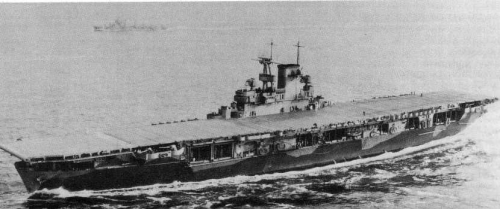
Wasp 1942
Ships
| No | Name | Yard No | Builder | Laid down | Launched | Comm | Fate |
|---|---|---|---|---|---|---|---|
| CV7 | Wasp | 1460 | Bethlehem, Quincy | 1.4.1936 | 4.4.1939 | 25.4.1940 | sunk 15.9.1942 |
Technical data
| Displacement standard, t | 15752 |
|---|---|
| Displacement full, t | 19116 |
| Length, m | 210.3 wl 219.5 oa |
| Breadth, m | 24.9 wl 30.5 oa |
| Draught, m | 7.08 full load |
| No of shafts | 2 |
| Machinery | 2 sets Parsons geared steam turbines, 6 Yarrow boilers |
| Power, h. p. | 70000 |
| Max speed, kts | 29.5 |
| Fuel, t | oil 1602 |
| Endurance, nm(kts) | 7500 (15) |
| Armour, mm | belt: 16mm plating, deck: 32 |
| Armament | 8 x 1 - 127/38 Mk 12, 4 x 4 - 28/75 Mk 1, 24 x 1 - 12.7/90, 76 aircraft (F2F, F3F, F2A Buffalo fighters, BG, SBU, SBC Helldiver, SB2U Vindicator, BT diving bombers, TBD Devastator torpedo bombers, SOC Seagull reconnaissance planes) |
| Complement | 2167 |
Air group
| Year | Fighters | dive bombers | torpedo bombers |
|---|---|---|---|
| 12.1941 | 47 F4F Wildcat | 33 SB2U Vindicator | 3 TBD Devastator |
| 8.1942 | 29 F4F Wildcat | 30 SBD Dauntless | 10 TBF Avenger |
Standard scale images
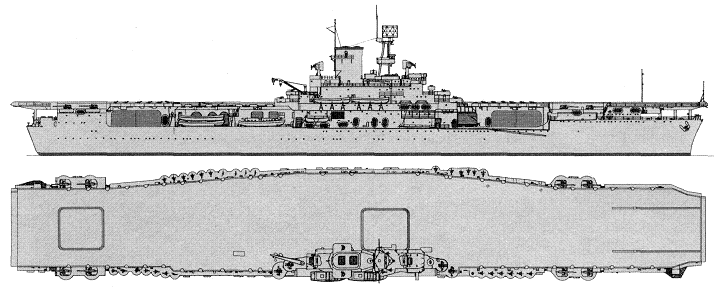
Wasp 1942
Graphics
Wasp 1942
Aircraft facilities
(fd - 6,893 m², ha - 3,055 m² / 15,976 m³): Flight deck: 226.0 x 30.5 m. Hangar: 159.1 x 19.2 x 5.23 m. There were 2 elevators (14.6 x 13.4 m, 7.7 t) and 4 catapults H 2 (2 flight deck and 1 doubled athwartships catapult in hangar). Aircraft fuel stowage: 613 500 l.
Project history
The decision to built CV7 Wasp was accepted 27.3.1934, simultaneously with conversion of CV1 Langley to an airplane transport. In order to avoid excess of resolved by Washington Treaty summary displacement of USN aircraft carriers, it was necessary to limit displacement of new ship by 14700t. However, Americans have a little played a cunning trick: speaking about the freed tonnage, they have specified full displacement of Langley, and Wasp design have included it as displacement standard. Ship was ordered 19.9.1935. The Wasp design had some original features. Asymmetric hull became unique line of the ship: so designers indemnified weight of island superstructure without ballast stowage on a port. Besides, she differed by unusual arrangement of engine and boiler rooms in en echelone; it was repeated later in Essex design. As experiment, an additional T-shaped deck-edge elevator was fitted at fore part of portside. There were 4 catapults: two on flight deck and two more, arranged transverse, in hangar for launch the planes via the side ports. Because of the limited displacement armour protection was very light.
Ship protection
Only lower (main) deck over machinery had 32mm protection. Steering gear compartment was protected by 87mm belt and 31mm deck.
Modernizations 1.
1942: + CXAM-1 radar
spring 1942: - 18 x 1 - 12.7/90; + 1 x 1 - 40/56 Mk III, 32 x 1 - 20/70 Mk 4
Naval service
15.9.1942 Wasp was hit S from Guadalcanal (12°25'S, 164°08'E) by 3 torpedoes from Japanese submarine I19 and 6hrs later sunk by destroyer Lansdowne.