NAVYPEDIA
 Support the project with paypal
 HOME
HOME FIGHTING SHIPS OF THE WORLD
 UNITED STATES OF AMERICA
 AIRCRAFT CARRYING SHIPS
 SAIPAN light aircraft carriers (1946 - 1947)
Ships
| No | Name | Yard No | Builder | Laid down | Launched | Comm | Fate |
|---|---|---|---|---|---|---|---|
| CVL48, 5.1959- AVT6, 1.1964- CC3, 8.1965- AGMR2 | Saipan, 4.1965- Arlington | 469 | New York SB, Camden | 10.7.1944 | 8.7.1945 | 14.7.1946 | aviation transport 5.1959, communications relay ship 8.1966, stricken 8.1975 |
| CVL49, 5.1959- AVT7, 5.1963 - CC2 | Wright | 470 | New York SB, Camden | 21.8.1944 | 1.9.1945 | 9.2.1947 | aviation transport 5.1959, NECPA command ship 5.1963, stricken 12.1977 |
Technical data
| Displacement standard, t | 15118 |
14500 |
|---|---|---|
| Displacement full, t | 18750 |
19600 |
| Length, m | 202.4 wl 208.4 oa |
202.4 wl 208.4 oa |
| Breadth, m | 23.4 wl 32.9 oa |
23.6 |
| Draught, m | 8.22 full load |
8.50 |
| No of shafts | 4 |
4 |
| Machinery | 4 sets General Electric geared steam turbines, 4 Babcock & Wilcox boilers |
4 sets General Electric geared steam turbines, 4 Babcock & Wilcox boilers |
| Power, h. p. | 120000 |
120000 |
| Max speed, kts | 33 |
33 |
| Fuel, t | oil 2400 max |
oil 3371 |
| Endurance, nm(kts) | 13000 (15) | 11700 (14) |
| Armour, mm | belt: 102 on 16mm plating, bulkheads: 102, main deck: 64 |
belt: 102 on 16mm plating, bulkheads: 102, main deck: 64 |
| Armament | CVL48: 5 x 4 - 40/60 Mk 2, 10 x 2 - 40/60 Mk 1, 16 x 2 - 20/70 Mk 24, 48 aircraft (F4U Corsair, F6F Hellcat, F7F Tigercat, FR Fireball, F8F Bearcat fighters, SB2C Helldiver dive bombers, TBF/TBM Avenger torpedo bombers, F4U-P Corsair, F6F-P Hellcat, F8F-P Bearcat reconnaissance planes, TBM-S Avenger ASW planes, TBM-W Avenger EW planes, TBM-R Avenger cargo planes) CVL49: 5 x 4 - 40/60 Mk 2, 10 x 2 - 40/60 Mk 1, 16 x 2 - 20/70 Mk 24, 48 aircraft (F4U Corsair, F6F Hellcat, F7F Tigercat, FR Fireball, F8F Bearcat fighters, SB2C Helldiver dive bombers, AD Skyraider attackers, TBF/TBM Avenger torpedo bombers, F4U-P Corsair, F6F-P Hellcat, F8F-P Bearcat reconnaissance planes, TBM-S Avenger ASW planes, TBM-W Avenger EW planes, AD-Q Skyraider ECM planes, TBM-R Avenger cargo planes) |
AGMR2: 4 x 2 - 76/50 Mk 33 CC2: 4 x 2 - 40/60 Mk 1, 6 helicopters (3 CH-46, 3 HH-43) |
| Electronic equipment | CVL48: SP, SK-2, SG radars, TDY ECM suite CVL49: SP, SR, SR-2, SG radars, TDY ECM suite |
SPS-6B radar, WLR-1, ULQ-6 ECM suites |
| Complement | 1821 |
1317 (additionally 522 flag on CC2) |
Air group
| Year | Fighters | torpedo bombers |
|---|---|---|
| 1946 | 36 F6F and F4U | 12 TBM |
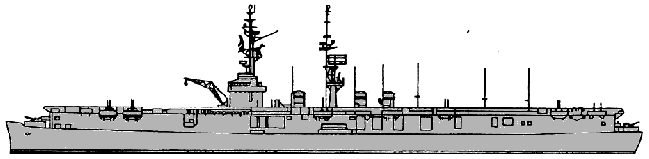
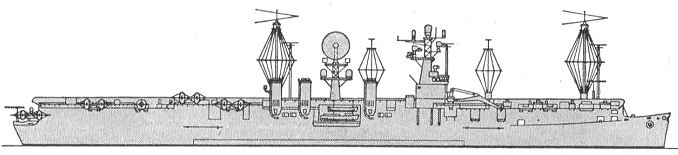
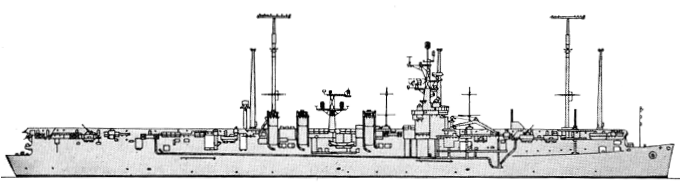
Standard scale images
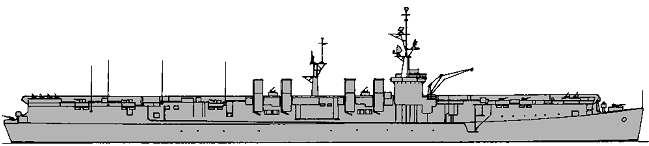
Saipan 1946
Wright 1953
Wright 1963
Wright 1968
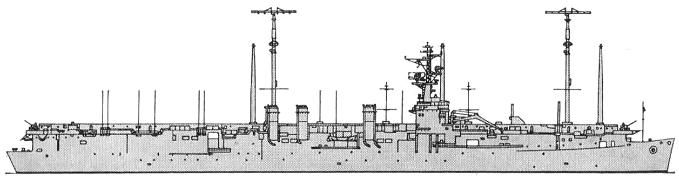
Arlington 1968
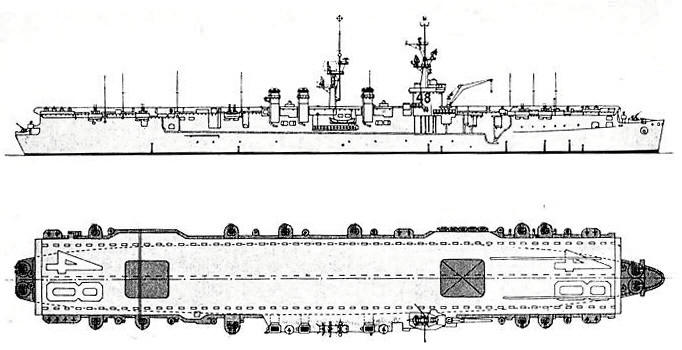
Saipan 1954
Aircraft facilities
(fd - 4,543 m², ha - 1,793 m² / 9,680 m³): Flight deck: 186.2 x 24.4 m. Hangar: 86.6 x 20.7 x 5.4 m. There were 2 lifts in center line (13.6 t, 14.6 x 13.4 m). There were 2 H 2-1 catapults. Aircraft fuel stowage: 543 100 l.
Project history
In 1943 admiral King ordered to continue building of two light aircraft carriers per year to replace expected losses, two new ships would be completed in December 1945. New ships were to be based on Baltimore heavy cruiser hull. It was not planned to convert existing cruisers but use of already produced hull would simplify design and building. Really an entirely new hull was designed, without bulges. Protection was generally on the Essex carrier scale and was stronger than on Baltimore; flight deck was strengthened to take 9t aircraft, new island, similar to Commencement Bay, was provided. Only two ships were built, by the time another pair might nave been ordered, the war ended. Both ships were rather cramped for jet aircraft and were soon laid up.
In 1961 the threat of Soviet ICBMs seemed increasingly acute and it appeared that no fixed US command centres would be secure in wartime. The Navy proposed the use of surface ships off the coasts. In an emergency President could be carried to them by helicopter and communicate with military forces by newly developed tropo-scatter radio. Under FY62 Wright was refitted to command ship (CC2) to serve as National Emergency Command Post Afloat (NECPA) with large antenna farm. Plans to convert Saipan as third NECPA ship (first was CC1 Northampton) were cancelled and she was converted to major communications relay ship (AGMR2 Arlington). Both NECPA ships were decommissioned in the spring of 1970: the number of Soviet submarines operational in the North Atlantic in peacetime had strongly reduced chances NECPAs if war could begin. Attention of US command turned to an airborn command posts.
Ship protection
102mm belt was closed by 102mm bulkheads and 64mm main deck. Steering gear compartment was protected by 102mm belt and bulkheads, 64mm roof and 19mm deck. Thickness of main bulkheads decreased over main deck to 37mm. There was light underwater protection.
after modernization:102mm belt was closed by 102mm bulkheads and 64mm main deck. Steering gear compartment was protected by 102mm belt and bulkheads, 64mm roof and 19mm deck. Thickness of main bulkheads decreased over main deck to 37mm. There was light underwater protection.
Modernizations
1947-1948, both: - 1 H 2-1 catapult; + 1 H 4B catapult.
1950s, Saipan: - 16 x 2 - 20/70, SK-2 radar, TDY ECM suite, fore funnel was removed; + SPS-6 radar, WLR-1 ECM suite
1950s, Wright: - 16 x 2 - 20/70, SR radar, TDY ECM suite, fore funnel was removed; + SPS-6 radar, WLR-1 ECM suite
(1963-8/1966), Arlington was converted to communication relay ship and (3/1962-5/1963), Wright to NECPA (National Emergency Command Post Afloat) command cruiser. Data was as follows:
Naval service
No significant events.