NAVYPEDIA
 Support the project with paypal
 HOME
HOME FIGHTING SHIPS OF THE WORLD
 UNITED STATES OF AMERICA
 CRUISERS
 PENNSYLVANIA armoured cruisers (1905 - 1908)
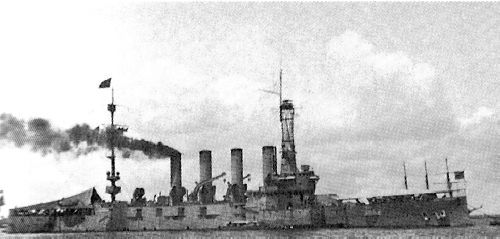
Photo
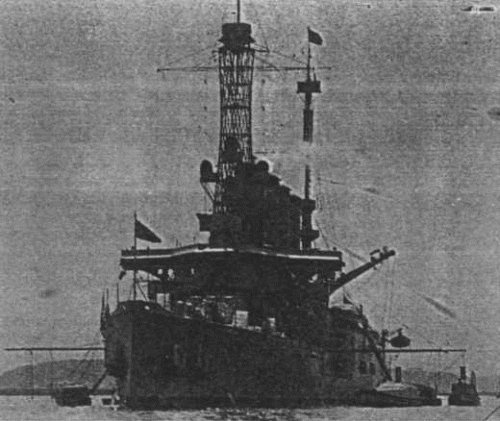
Pittsburgh 1919
Ships
| No | Name | Yard No | Builder | Laid down | Launched | Comm | Fate |
|---|---|---|---|---|---|---|---|
| ACR4, 7.1920- CA4 | Pennsylvania, 8.1912- Pittsburgh | 317 | Cramp, Philadelphia | 7.8.1901 | 22.8.1903 | 9.3.1905 | stricken 10.1931 |
| ACR5, 7.1920- CA5 | West Virginia, 11.1916- Huntington | 38 | Newport News | 16.9.1901 | 18.4.1903 | 23.2.1905 | stricken 3.1930 |
| ACR6 | California, 9.1914- San Diego | 78 | Union Iron Wks, San Francisco | 7.5.1902 | 28.4.1904 | 1.8.1907 | sunk 19.7.1918 |
| ACR7, 7.1920- CA7 | Colorado, 11.1916- Pueblo | 316 | Cramp, Philadelphia | 25.4.1901 | 25.4.1903 | 19.1.1905 | BU 10.1930 |
| ACR8, 7.1920- CA8 | Maryland, 11.1916- Frederick | 39 | Newport News | 29.10.1901 | 12.9.1903 | 18.4.1905 | stricken 11.1929 |
| ACR9, 7.1920- CA9 | South Dakota, 6.1920- Huron | 79 | Union Iron Wks, San Francisco | 30.9.1902 | 21.7.1904 | 27.1.1908 | stricken 11.1929 |
Technical data
| Displacement normal, t | 13680 |
|---|---|
| Displacement full, t | 15138 |
| Length, m | 153.6 |
| Breadth, m | 21.2 |
| Draught, m | 7.34 mean |
| No of shafts | 2 |
| Machinery | ACR4, 7: 2 VTE, 32 Niclausse boilers ACR5, 6, 8, 9: 2 VTE, 16 Babcock & Wilcox boilers |
| Power, h. p. | 23000 |
| Max speed, kts | 22 |
| Fuel, t | ACR4, 7: coal 1980 ACR5, 8: coal 1850 ACR6, 9: coal 2075 |
| Endurance, nm(kts) | 5000(10) |
| Armour, mm | Krupp and Harvey steel - belt: 152 - 127, (89 at ships ends), deck: 102 - 38, barbettes: 152 - 76, turrets: 165 - 152, casemates: 127, CT: 229 |
| Armament | 2 x 2 - 203/42 Mk V, 14 x 1 - 152/49 Mk VI/VIII, 18 x 1 - 76/50 Mk III/V/VI, 12 x 1 - 47/40-45 Driggs-Schroeder Mk I/II, 2 x 1 - 37/40 Driggs-Schroeder heavy Mk I, 2 - 450 TT (beam) |
| Complement | 829 - 928 |
Standard scale images
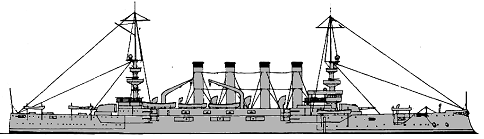
Maryland 1905
Graphics
Pittsburgh 1919
Huron 1923
Project history
Authorized under the Acts of 3.3.1899 (first three) and 7.6.1900 (second three). Much larger than the two previous US armoured cruisers, they were distinctly undergunned for their size.
Ship protection
Main belt protected machinery only. Its thickness was 127mm except 152mm waterline. Armoured deck over citadel was 38mm behind the belt at flat part and connected with lower belt edge by 102mm slopes. This deck was 102mm with 102mm slopes at ship ends. Barbette bases and ammunition tubes had 76mm protection. Upper part of barbettes was 152mm thick. Turrets had 165-152mm sides and 38mm crowns. Secondary guns were protected by 127mm casemates.
Modernizations
1909 - 1911, all: - 2 x 2 - 203/42; + 2 x 2 - 203/45 Mk VI; new cage foremasts were installed
1914 - 1919, Pittsburgh: - 6 x 1 - 152/50 (may be temporarily), (6 - 8) x 1 - 76/50; + 2 x 1 - 76/52 Mk X; boilers were replaced by 16 Babcock & Wilcox
1914 - 1919, Huntington, San Diego, Frederick, Huron: - 10 x 1 - 152/50 (may be temporarily), (6 - 8) x 1 - 76/50; + 2 x 1 - 76/52 Mk X
1914 - 1919, Pueblo: - 10 x 1 - 152/50 (may be temporarily), (6 - 8) x 1 - 76/50; + 2 x 1 - 76/52 Mk X; boilers were replaced by 16 Babcock & Wilcox
1917, Huntington (temporarily): + 1 catapult, 4 airplanes, 1 balloon
1922, Pittsburgh: 4 boilers and 1 funnel were removed.
Naval service
Huntington was finally decommissioned in 1920, Frederick in 1922, Huron and Pueblo in 1927, the latter after six years as a receiving ship al New York, and Pittsburg in 1931. San Diego was 19.7.1918 either mined or torpedoed by German submarine U156 and capsized and sank in about 20 minutes.