NAVYPEDIA
 Support the project with paypal
 HOME
HOME FIGHTING SHIPS OF THE WORLD
 UNITED STATES OF AMERICA
 CRUISERS
 BROOKLYN light cruisers (1938 - 1939)
Photo
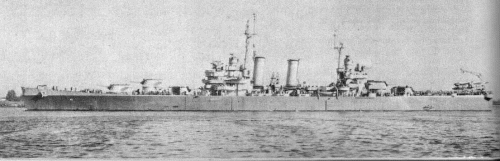
Philadelphia 1945 Thanks to Massimiliano Stola for the help in error correction in "Modernizations".
Ships
| No | Name | Builder | Laid down | Launched | Comm | Fate |
|---|---|---|---|---|---|---|
| CL40 | Brooklyn | New York N Yd, Brooklyn | 12.3.1935 | 30.11.1936 | 18.7.1938 | to Chile 1.1951 (O'Higgins) |
| CL41 | Philadelphia | Philadelphia N Yd | 28.5.1935 | 17.11.1936 | 28.7.1938 | to Brazil 1.1951 (Barroso) |
| CL42 | Savannah | New York SB, Camden | 31.5.1934 | 8.5.1937 | 30.8.1938 | stricken 3.1959 |
| CL43 | Nashville | New York SB, Camden | 24.1.1935 | 2.10.1937 | 25.11.1938 | to Chile 1.1951 (Capitán Prat) |
| CL46 | Phoenix | New York SB, Camden | 15.4.1935 | 12.3.1938 | 18.3.1939 | to Argentina 1.1951 (Diecisiete de Octubre (17 de Octubre)) |
| CL47 | Boise | Newport News | 1.4.1935 | 3.12.1936 | 1.2.1939 | to Argentina 1.1951 (Nueve de Julio (9 de Julio)) |
| CL48 | Honolulu | New York N Yd, Brooklyn | 10.9.1935 | 26.8.1937 | 7.9.1938 | stricken 3.1959 |
| CL49 | St. Louis | Newport News | 10.12.1936 | 15.4.1938 | 12.1939 | to Brazil 1.1951 (Tamandaré) |
| CL50 | Helena | New York N Yd, Brooklyn | 9.12.1936 | 28.8.1938 | 14.12.1939 | sunk 6.7.1943 |
Technical data
| Displacement standard, t | CL40 - 43, 46 - 48: 9475 - 9800 CL49, 50: 10560 |
|---|---|
| Displacement full, t | CL40 - 43, 46 - 48: 12243 - 12700 CL49, 50: 13327 |
| Length, m | 182.9 wl 185.4 oa |
| Breadth, m | 18.8 |
| Draught, m | CL40 - 43, 46 - 48: 6.54 - 6.94 full load CL49, 50: 6.96 - 7.37 full load |
| No of shafts | 4 |
| Machinery | 4 sets Westinghouse geared steam turbines, 8 Babcock & Wilcox boilers |
| Power, h. p. | 100000 |
| Max speed, kts | 32.5 |
| Fuel, t | oil 1321 - 1982 |
| Endurance, nm(kts) | 10000 (15) |
| Armour, mm | CL40 - 43, 46 - 48: belt: 127 - 83, magazines belts: 51 (fore) - 120 (aft), bulkheads: 127 - 51, deck: 51, barbettes: 152, turrets: 165 - 32, CT: 127 sides, 57 roof CL49, 50: belt: 127 - 83, magazines belts: 51 (fore) - 120 (aft), bulkheads: 127 - 51, deck: 51, barbettes: 152, turrets: 165 - 32, secondary gunhouses: 32 - 25, CT: 127 sides, 57 roof |
| Armament | CL40 - 43, 46 - 48: 5 x 3 - 152/47 Mk 16, 8 x 1 - 127/25 Mk 10.11.13, 8 x 1 - 12.7/90, 2 catapults, 4 seaplanes (O3U, SOC) CL49, 50: 5 x 3 - 152/47 Mk 16, 4 x 2 - 127/38 Mk 12, 8 x 1 - 12.7/90, 2 catapults, 4 seaplanes (SOC) |
| Complement | 868 |
Standard scale images
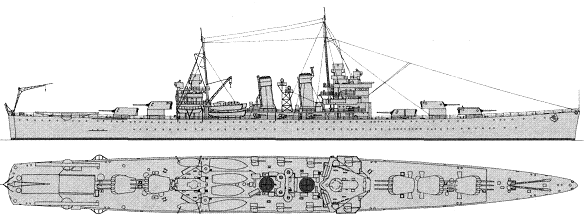
Brooklyn 1941
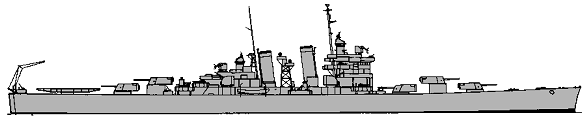
St. Louis 1942
Graphics
" />
Philadelphia 1945 Thanks to Massimiliano Stola for the help in error correction in "Modernizations".
Project history
The 1930 London Naval conference limited number of cruisers with 203mm artillery, and the attention of shipbuilders was forcedly switched to the ships with 152mm guns. Originally in the USA there was a judgement, that within the limits of 10000t displacements it is really to create the ship with dozen of 152mm guns and better protection, than at existing 203mm cruisers. Such ship theoretically could benefit a duel with the more heavy armed opponent for the account of higher firing rate of 152mm guns. However this calculation was plotted on a duel with 'Washington' cruiser of the first generation. Occurrence of well protected New Orleans class ships led to that in new designed cruisers the thrust on increasing of number of 152mm guns to the detriment of protection has been laid. Design works were started in the fall of 1930. From six offered variants (from 6000 to 10000t displacement and from 6 to 15 152mm guns) in 1931 the design of 9600t ship with 12 guns in four triple turrets have been chosen. The armouring scheme basically repeated accepted on New Orleans class. It was supposed to include building of such ship into FY1933 program, however for some reasons it has not happened. It was offered to provide installation of 28mm MGs. Search of a place for them has led to moving of catapults and a hangar astern.
In March, 1932 for discussion of General council new designs of a cruiser with 152mm artillery (10000t displacement, from 12 to 16 152mm guns, 127mm belt) have been presented. Finally it was solved to build a variant with 15 152mm guns in five triple turrets. The choice was influenced by the data which have appeared about Japanese-built cruisers of Mogami class, having at displacement 8500t 15 155mm guns (the maximum calibre resolved by London conference). In the project approved in 1933, there was a number of innovations. A hull form resembled New Orleans, but forecastle extension in a stern to the stern frame has converted it into flush-decked. The set was fulfilled on longitudinal framing that has allowed to save weight. The upper deck raising in a stern has allowed to place a hangar and catapults on a quarter-deck, having freed space around a superstructure. A number of lacks of the design was caused, first of all, by necessity of observance of contractual limitations. So, machinery arrangement remained linear, as well as on New Orleans. The hull was too weak and has demanded to be strengthened. The armouring scheme basically repeated accepted on New Orleans, but in some elements was more thin. The immune zone of new cruisers under fire of 152mm guns at a relative 60° bearing was in a band 40-115 cables. Besides new 152/47mm Mk 16 guns, cruisers were armed by 8 127/25mm AA guns. Provided by the design 28mm MGs were not ready, and close AA armament consisted of only 12.7mm MGs.
Under the emergency FY1933 programme 4 ships (CL40-44) were ordered, 3 more in FY1934 (CL46-48). Later 2 more ships were added (CL49 and 50) for replacement of the first cruisers of Omaha class; they were built under improved design. Usage of new compact high-pressure boilers allowed to shrink the sizes of boiler rooms. It, in turn, has given the chance to rearrange machinery, returning to en echelon scheme. Besides, single 127/25mm AA guns were replaced by new twin mounts.
Ship protection
Main belt abreast machinery was 4.2m high. It was 127mm thick (83mm at lower edge) on 16mm STS plating. There were narrow belts abreast magazines. Fore belt was 51mm thick but aft inner belt had 120mm thickness. Magazines were protected by 93mm bulkheads fore and aft, machinery and magazines were separated by 127-51mm bulkheads. Armoured deck over main belt was 51mm. Barbettes were 152mm thick. Turrets had 165-mm faces, 32-mm sides, 32-mm rears and 51-mm crowns.
Modernizations
mid-1941, all: + 2 x 1 - 76/50 Mk 20; 2 x 4 - 28/75 Mk 1
late 1941, Philadelphia, Helena; 12.1941, Honolulu: - 2 x 1 - 76/50; + 2 x 4 - 28/75 Mk 1, Mk 3 radar
12/1941, Phoenix: + 2 x 4 - 28/75 Mk 1, Mk 3 radar
12/1941, Helena: - 4 x 4 - 28/75
1/1942, Honolulu: + 8 x 1 - 20/70 Mk 4, Mk 3 radar
1/1942, Brooklyn, St. Louis; 4.1942, Nashville; 6.1942, Boise: - 2 x 1 - 76/50; + 2 x 4 - 28/75 Mk 1, 8 x 1 - 20/70 Mk 4, Mk 3 radar
late 1942, all: - 8 x 1 - 12.7/90; + SC, SG, 2x Mk 4 radars
8/1942, Savannah; 2.1943, Phoenix: - 2 x 1 - 76/50, 4 x 4 - 28/75; + 4 x 4 - 40/56 Mk 1.2, 4 x 2 - 40/56 Mk 1.2, 12 x 1 - 20/70 Mk 4, Mk 3 radar
late 1942, St. Louis: - 4 x 4 - 28/75; + 4 x 4 - 40/56 Mk 1.2, 4 x 2 - 40/56 Mk 1.2, 4 x 1 - 20/70 Mk 4
late 1942, Helena: + 4 x 4 - 40/56 Mk 1.2, 4 x 2 - 40/56 Mk 1.2, 12 x 1 - 20/70 Mk 4
early 1943, Brooklyn, Nashville, Boise: - 4 x 4 - 28/75; + 4 x 4 - 40/56 Mk 1.2, 4 x 2 - 40/56 Mk 1.2, 4 x 1 - 20/70 Mk 4
early 1943, Philadelphia: - 4 x 4 - 28/75; + 4 x 4 - 40/56 Mk 1.2, 4 x 2 - 40/56 Mk 1.2, 12 x 1 - 20/70 Mk 4
11/1943, Honolulu: - 4 x 4 - 28/75; + 4 x 4 - 40/56 Mk 1.2, 4 x 2 - 40/56 Mk 1.2, 4 x 1 - 20/70 MK 4
1943 - 1945, Brooklyn, Phoenix: - SC radar; + SK radar
1943 - 1945, Philadelphia: - SC, Mk 3 radars; + SK, Mk 13 radars
1943 - 1945, Savannah, Honolulu: - SC, Mk 3 radars; + SK, Mk 8 radars
1943 - 1945, Nashville, Boise: - SC, Mk 3, 2x Mk 4 radars; + SK, Mk 13, 2x Mk 28 radars
1943 - 1945, St. Louis: - SC, Mk 3, 2x Mk 4 radars; + SK-2, Mk 8, 2x Mk 28 radars
1944 - 1945, Brooklyn, Philadelphia, Savannah, Honolulu: - 12 x 1 - 20/70; + 2 x 2 - 40/56 Mk 1.2, 10 x 2 - 20/70 Mk 4, CT was removed
1944 - 1945, Nashville: - 12 x 1 - 20/70; + 2 x 2 - 40/56 Mk 1.2, 9 x 2 - 20/70 Mk 4, CT was removed
1944 - 1945, Phoenix: + 7 x 1 - 20/70 Mk 4, CT was removed
1944 - 1945, Boise: + 6 x 1 - 20/70 Mk 4, CT was removed
1944 - 1945, St. Louis: - 4 x 1 - 20/70; + 2 x 2 - 40/56 MK 1.2, CT was removed
9/1944, Savannah: new bulges were fitted, breadth increased to 21.2 m; - 8 x 1 - 127/25, 2x Mk 4 radars; + 4 x 2 - 127/38 Mk 12, 2x Mk 12.22 radars
1945, Brooklyn, Philadelphia, Honolulu: new bulges were fitted, breadth increased to 21.2m
1/1946, Brooklyn: 5 x 3 - 152/47 Mk 16, 8 x 1 - 127/25 Mk 27, 4 x 4 - 40/60 Mk 2, 6 x 2 - 40/60 Mk 1, 10 x 2 - 20/70 Mk 24, 2 catapults, 4 seaplanes, SK, SG, Mk 3, 2x Mk 4 radars
1/1946, Philadelphia: 5 x 3 - 152/47 Mk 16, 8 x 1 - 127/25 Mk 27, 4 x 4 - 40/60 Mk 2, 6 x 2 - 40/60 Mk 1, 10 x 2 - 20/70 Mk 24, 2 catapults, 4 seaplanes, SK, SG, Mk 13, 2x Mk 4 radars
1/1946, Savannah: 5 x 3 - 152/47 Mk 16, 4 x 2 - 127/38 Mk 32, 4 x 4 - 40/60 Mk 2, 6 x 2 - 40/60 Mk 1, 10 x 2 - 20/70 Mk 24, 2 catapults, 4 seaplanes, SK, SG, Mk 8, 2x Mk 12.22 radars
1/1946, Nashville: 5 x 3 - 152/47 Mk 16, 8 x 1 - 127/25 Mk 27, 4 x 4 - 40/60 Mk 2, 6 x 2 - 40/60 Mk 1, 9 x 2 - 20/70 Mk 24, 2 catapults, 4 seaplanes, SK, SG, Mk 13, 2x Mk 28 radars
1/1946, Phoenix: 5 x 3 - 152/47 Mk 16, 8 x 1 - 127/25 Mk 27, 4 x 4 - 40/60 Mk 2, 6 x 2 - 40/60 Mk 1, 19 x 1 - 20/70 Mk 10, 2 catapults, 4 seaplanes, SK, SG, Mk 3, 2x Mk 4 radars
1/1946: Boise: 5 x 3 - 152/47 Mk 16, 8 x 1 - 127/25 Mk 27, 4 x 4 - 40/60 Mk 2, 6 x 2 - 40/60 Mk 1, 18 x 1 - 20/70 Mk 10, 2 catapults, 4 seaplanes, SK, SG, Mk 13, 2x Mk 28 radars
1/1946, Honolulu: 5 x 3 - 152/47 Mk 16, 8 x 1 - 127/25 Mk 27, 4 x 4 - 40/60 Mk 2, 6 x 2 - 40/60 Mk 1, 10 x 2 - 20/70 Mk 24, 2 catapults, 4 seaplanes, SK, SG, Mk 8, 2x Mk 4 radars
1/1946, St. Louis: 5 x 3 - 152/47 Mk 16, 4 x 2 - 127/38 Mk 29, 4 x 4 - 40/60 Mk 2, 6 x 2 - 40/60 Mk 1, 8 x 1 - 20/70 Mk 10, 2 catapults, 4 seaplanes, SK-2, SG, Mk 8, 2x Mk 28 radars
Naval service
Helena 7.12.1941 in Pearl Harbour received an air torpedo hit, repaired till May, 1942; 6.7.1943 in battle in Kula Bay she received three torpedo hits from Japanese destroyers Tanikaze and Suzukaze, broken apart and sunk. Brooklyn at coast of Sicily was damaged by a mine 14.7.1943 and was under repair till December, 1943. Savannah 11.9.1943 was badly damaged at Salerno by German planning air bomb, was under repair till September, 1944. Nashville 12.5.1943 was damaged by internal explosion of a gun turret No1, returned to service in August, 1943; 13.12.1944 she was damaged by kamikaze and was under repair till April, 1945. Boise ran ashore 21.1.1942 and was under repair till June, 1942; 11.10.1942 in battle at Cape Esperance she was badly damaged by gunfire of Japanese ships and returned to service in March, 1943. Honolulu 13.7.1943 was damaged by a torpedo from Japanese ship, fore end on a capstan was broken off; repair lasted till November, 1943; 20.10.1944 she was damaged by Japanese air torpedo and was under repair till October, 1945. St. Louis 13.7.1943 was damaged by a torpedo from Japanese destroyer, fore end was broken off, repair lasted till November, 1943; 14.2.1944 she was damaged by Japanese air bomb and was under repair till May, 1944; 27.11.1944 she was damaged by kamikaze and returned to service in March, 1945.
Thanks to Massimiliano Stola for the help in error correction in "Modernizations".