NAVYPEDIA
 Support the project with paypal
 HOME
HOME FIGHTING SHIPS OF THE WORLD
 UNITED STATES OF AMERICA
 AMPHIBIOUS SHIPS AND CRAFT
 HEYWOOD amphibious personnel transports (1918 - 1919 / 1941)
Photo
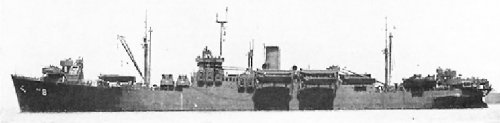
William P. Biddle
Ships
No |
Name |
Yard No | Builder |
Laid down |
Launched |
Comm |
Fate |
|---|---|---|---|---|---|---|---|
AP12, 2.1943- APA6 |
Heywood (ex-City of Baltimore, ex-Steadfast) |
170 | Bethlehem, San Francisco // |
1919 |
1919 |
5.1919 // 1941 |
for disposal 7.1946 |
AP14, 2.1943- APA7 |
Fuller (ex-City of Newport News, ex-Archer) |
169 | Bethlehem, San Francisco // |
1919 |
1919 |
2.1919 // 4.1941 |
to Maritime Comm. 7.1946 |
AP15, 2.1943- APA8 |
William P. Biddle (ex-City of San Francisco, ex-City of Hamburg, ex-Eclipse) |
168 | Bethlehem, San Francisco // Moore DD |
1919 |
2.1919 // 2.1941 |
stricken 6.1946 |
|
AP16, 2.1943- APA9 |
Neville (ex-City of Norfolk, ex-Independence) |
162 | Bethlehem, San Francisco // Willamette Iron |
1918 |
11.1918 // 5.1941 |
stricken 8.1946 |
Technical data
| Displacement standard, t | 8789 |
|---|---|
| Displacement full, t | 14450 |
| Length, m | 154.5 |
| Breadth, m | 17.1 |
| Draught, m | 7.80 |
| No of shafts | 1 |
| Machinery | De Laval geared steam turbine, 4 Babcock & Wilcox boilers |
| Power, h. p. | 9500 |
| Max speed, kts | 16.8 |
| Fuel, t | oil 1523 |
| Endurance, nm(kts) | 9000(12) |
| Armament | 4 x 1 - 76/50 Mk 10.17, 4 x 1 - 12.7/90 |
| Military load | 22 LCVP, 2 - 4 LCM(3), cargo, 1278 troops by 1945: 4 LCM(6), 21 LCVP, 1 LCPL, 1 LCPR, 2900t of cargo, 1275 marines |
| Complement | 550 |
Graphics
William P. Biddle
Project history
USN military transport vessels were sectioned into two groups: АР for transportation of troops and АК for carriage of goods and technics. The majority of them were built on the basis of standard types С2, С3 and С4 and differed from usual cargo ships a little.
For delivery of troops and cargoes directly to a beaching place assault landing transport ships (АРА and АКА) served, which main difference from АК and АР consisted that they were extra equipped with disembarkation craft of LCVP, LCM and LCP (L) types; with their help delivery of people and cargoes to beach also was effected.
Originally similar ships were not outlined in own subclass and were registered as АР and АК. In February, 1943 reorganisation was done and assault transports have received indexation АРА and АКА.
Two ships of Doyen class, projected even on the eve of war for landing operations in Caribbean basin, became the first American assault military transports. The overwhelming majority of remaining АРА and АКА has been converted from merchant cargo and cargo-passenger vessels or constructed in hulls of standard cargo vessels built by the big series in days of war. An exception were specially projected as assault transports Gilliam (АРА) and Artemis (АКА) classes.
Besides the large landing transport ships of АРА and АКА classes, small landing parties and subversive groups were landed by fast landing transports (APD) converted from become outdated Wickes and Clemson classes destroyers and destroyer escorts of Buckley and Rudderow classes.
Heywood class transports were former passenger liners of Baltimore Mail Line Co.
Modernizations
by 1945 ships were armed with 4 x 1 - 76/50 Mk 10.17, 2 x 2 - 40/56 Mk 1.2, 16 x 1 - 20/70 Mk 4, SC or SF or SL or SN or SO or SU radar
1/1946: 4 x 1 - 76/50 Mk 20/21, 2 x 2 - 40/60 Mk 1, 16 x 1 - 20/70 Mk 10, SC or SF or SL or SN or SO or SU radar
Naval service
No significant events.
© Ivan Gogin, 2014-15