NAVYPEDIA
 Support the project with paypal
 HOME
HOME FIGHTING SHIPS OF THE WORLD
 UNITED KINGDOM
 SUBMARINES
 "L" submarines (L1) (8, 1917 - 1918)
Ships
| Name | No | Yard No | Builder | Laid down | Launched | Comp | Fate |
|---|---|---|---|---|---|---|---|
| L1 (ex-E57) | Vickers, Barrow | 5.1916 | 10.5.1917 | 11.1917 | sold 3.1930 | ||
| L2 (ex-E58) | Vickers, Barrow | 5.1916 | 6.7.1917 | 12.1917 | sold 3.1930 | ||
| L3 | Vickers, Barrow | 6.1916 | 1.9.1917 | 1.1918 | sold 2.1931 | ||
| L4 | Vickers, Barrow | 6.1916 | 17.11.1917 | 2/1918 | sold 2.1934 | ||
| L5 | Swan Hunter, Wallsend | 8.1916 | 26.1.1918 | 5.1918 | sold 1931 | ||
| L6 | Beardmore, Dalmuir | 10/1916 | 14.1.1918 | 7/1918 | sold 1.1935 | ||
| L7 | Cammell Laird, Birkenhead | 5/1916 | 24.4.1917 | 12.1917 | sold 2.1930 | ||
| L8 | Cammell Laird, Birkenhead | 5.1916 | 7.7.1917 | 3.1918 | sold 10.1930 |
Technical data
| Displacement standard, t | |
|---|---|
| Displacement normal, t | 891 / 1074 |
| Length, m | 70.4 |
| Breadth, m | 7.15 |
| Draught, m | 4.04 |
| No of shafts | 2 |
| Machinery | 2 Vickers diesels / 2 electric motors |
| Power, h. p. | 2400 / 1600 |
| Max speed, kts | 17 / 10.5 |
| Fuel, t | diesel oil 78 |
| Endurance, nm(kts) | 3800(10) / 200(2) |
| Armament | L1 - 4, 7: 1 x 1 - 76/45 20cwt QF Mk II, 6 - 450 TT (4 bow, 2 beam, 10) L5, 8: 1 x 1 - 102/40 QF Mk IV, 6 - 450 TT (4 bow, 2 beam, 10) L6: 1 x 1 - 102/41 QF Mk VII, 6 - 450 TT (4 bow, 2 beam, 10) |
| Complement | 35 |
| Diving depth operational, m | 50 |
Standard scale images
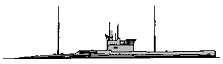
L6 1918
Project history
By 1916 there was an urgent need for a design to replace the 'E' class, which despite its wartime improvements was six years old, and hard to 'stretch' to accommodate further improvements. Alter all the experiments with double-and partially double-hulled boats, the Admiralty reverted in the well-tried saddle-tank design, but with higher speeds. The first pair, E57 and E58 were only intended to be lengthened 'E's, but showed so many improvements that they were chosen as prototypes for a new class and numbered L1 and L2. These had been ordered in February 1916 and laid down three months later.
L3-L8 were ordered in May 1916, and they were completed between November 1917 and March 1918. Armament varied: L 1 had a 3in AA gun on a disappearing mounting, and initially some had no gun at all. Eventually all carried their 4in gun on a platform at the forward end of the conning tower,
Modernizations
1918, L1, L3: - 1 x 1 - 76/45; + 1 x 1 - 102/41 QF Mk VII
1918, L2, L4, L7: - 1 x 1 - 76/45; + 1 x 1 - 102/40 QF Mk IV
Naval service
No significant events.