NAVYPEDIA
 Support the project with paypal
 HOME
HOME FIGHTING SHIPS OF THE WORLD
 UNITED KINGDOM
 ESCORTS
 AZALEA fleet sweeping sloops (12, 1915)
Photo
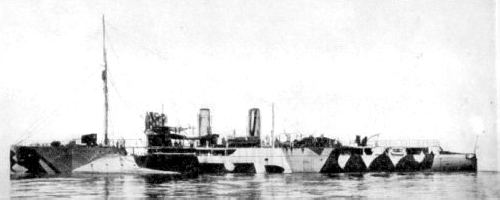
Primrose
Ships
| Name | No | Yard No | Builder | Laid down | Launched | Comp | Fate |
|---|---|---|---|---|---|---|---|
| Clematis | T35, T22 | 373 | Greenock & Grangemouth | 1915 | 29.7.1915 | 9/1915 | sold 2.1931 |
| Zinnia | T42, T92 | 1000 | Swan Hunter, Low Walker | 1915 | 12.8.1915 | 9.1915 | to Belgium 4.1920 (Zinnia) |
| Begonia | T33 | 532 | Barclay Curle, Whiteinch | 1915 | 26.8.1915 | 10.1915 | sunk 2.10.1917 |
| Carnation | T36, T13 | 374 | Greenock & Grangemouth | 1915 | 6.9.1915 | 10/1915 | sold 1.1922 |
| Jessamine | T43, T47 | 1002 | Swan Hunter, Low Walker | 1915 | 9.9.1915 | 10/1915 | sold 12.1922 |
| Heliotrope | T37, T41 | 805 | Lobnitz, Renfrew | 1915 | 10.9.1915 | 10/1915 | sold 1.1935 |
| Azalea | T32, T07 | 531 | Barclay Curle, Whiteinch | 1915 | 10.9.1915 | 10/1915 | sold 2.1923 |
| Narcissus | T41, T66 | 205 | Napier & Miller, Old Kirkpatrick | 1915 | 22.9.1915 | 11/1915 | sold 9.1922 |
| Camellia | T34, T15 | 319 | Bow McLachlan, Paisley | 1915 | 25.9.1915 | 11/1915 | sold 1.1923 |
| Peony | T39, T71 | 462 | Archibald & McMillan, Dumbarton | 1915 | 27.10.1915 | 12.1915 | sold 8.1919 |
| Snowdrop | T40, T80 | 463 | Archibald & McMillan, Dumbarton | 1915 | 7.10.1915 | 11/1915 | sold 1.1923 |
| Myrtle | T38, T65 | 806 | Lobnitz, Renfrew | 1915 | 11.10.1915 | 11.1915 | sunk 16.7.1919 |
Technical data
| Displacement normal, t | 1210 |
|---|---|
| Displacement full, t | 1275 |
| Length, m | 76.2 pp 80.0 oa |
| Breadth, m | 10.1 |
| Draught, m | 3.36 |
| No of shafts | 1 |
| Machinery | 1 VTE, 2 cylindrical boilers |
| Power, h. p. | 1800 |
| Max speed, kts | 16.5 |
| Fuel, t | coal 130 |
| Endurance, nm(kts) | 2000(15) |
| Armament | 2 x 1 - 120/40 QF Mk I/II/III/IV, 2 x 1 - 47/40 3pdr Hotchkiss Mk I, mechanical minesweeping gear some later ships: 2 x 1 - 102/44 BL Mk IX or 102/45 BL Mk X or 102/40 QF Mk IV, 2 x 1 - 47/40 3pdr Hotchkiss Mk I, mechanical minesweeping gear |
| Complement | 90 |
Graphics
Primrose
Project history
A repeat order for minesweeping sloops was placed in May 1915, but with heavier armament, in view of the likelihood of German raids on the sweeping flotillas. It was hoped to provide 120mm guns for them all, but the later ships had 102mm. In other respects they were virtually identical, and came into service in September-December 1915
Modernizations
1916 - 1917, all survived: + 2 DCT, 1 DCR
1916 - 1917, Begonia: was converted to decoy ship resembling a small coaster.
Naval service
Begonia was converted to a Q-Ship or antisubmarine decoy, being rebuilt at Haulbowline near Queenstown 1916-17 to resemble a small coaster. She recommissioned on 9 August 1917 and used the names Dolcis, Jessop and Q10. She was sunk in collision with the large U-boat U151 off Casablanca 2.10.1917. Myrtle was mined in the Gulf of Finland during operations against the Bolsheviks 16.7.1919, Zinnia was transferred to Belgium in April 1920 and retained her name.
Many thanks to Wolfgang Stöhr for additional information on this page.