NAVYPEDIA
 Support the project with paypal
 HOME
HOME FIGHTING SHIPS OF THE WORLD
 UNITED KINGDOM
 ESCORTS
 ARABIS fleet sweeping sloops (36, 1915 - 1916)
Photo
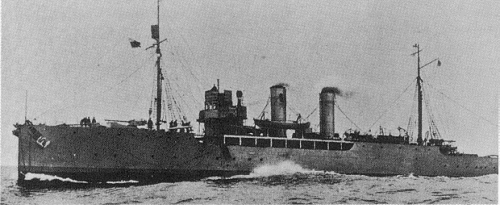
Primula 1916
Ships
| Name | No | Yard No | Builder | Laid down | Launched | Comp | Fate |
|---|---|---|---|---|---|---|---|
| Buttercup | T45, T14 | 534 | Barclay Curle, Whiteinch | 1915 | 24.10.1915 | 12.1915 | sold 2.1920 |
| Gladiolus | T50, T38 | 379 | Connell, Scotstoun | 1915 | 25.10.1915 | 1915 | to Portugal 3.1920 (Republica) |
| Alyssum | T46 | Earle, Hull | 1915 | 5.11.1915 | 1916 | sunk 18.3.1917 | |
| Arabis | T44 | 497 | Henderson, Glasgow | 1915 | 6.11.1915 | 1916 | sunk 10.2.1916 |
| Wallflower | T78, T89 | 575 | Irvine, West Hartlepool | 1915 | 8.11.1915 | 1916 | sold 8.1931 |
| Poppy | T47, T74 | 1004 | Swan Hunter, Low Walker | 1915 | 9.11.1915 | 12/1915 | sold 4.1923 |
| Verbena | T77, T86 | Blyth SB, Cowpen Quay | 1915 | 9.11.1915 | 1916 | sold 10.1933 | |
| Rosemary | T58, T77 | 661 | Richardson Duck, Thornaby | 1915 | 22.11.1915 | 12.1915 | sold 12.1947 |
| Marguerite (1919- RAN) | T51, T60 | 291 | Dunlop Bremner, Port Glasgow | 7/1915 | 23.11.1915 | 1916 | dismantled 9.1932 |
| Primula | T55 | 1006 | Swan Hunter, Low Walker | 1915 | 6.12.1915 | 1.1916 | sunk 1.3.1916 |
| Wisteria | T79, T91 | 576 | Irvine, West Hartlepool | 1915 | 7.12.1915 | 1916 | sold 1.1931 |
| Amaryllis | T69, T02 | Earle, Hull | 1915 | 9.12.1915 | 1916 | sold 1.1923 | |
| Nigella | T52, T68 | 314 | Hamilton, Port Glasgow | 1915 | 10.12.1915 | 1916 | sold 11.1922 |
| Asphodel | T70, T04 | 498 | Henderson, Glasgow | 1915 | 21.12.1915 | 2.1916 | to Denmark 6.1920 (Fylla) |
| Nasturtium | T76 | 464 | Archibald & McMillan, Dumbarton | 1915 | 21.12.1915 | 1916 | sunk 27.4.1916 |
| Snapdragon | T71, T79 | 518 | Ropner, Stockton | 1915 | 21.12.1915 | 1916 | sold 5.1934 |
| Gentian | T49, T36 | 376 | Greenock & Grangemouth | 1915 | 23.12.1915 | 2.1916 | sunk 16.7.1919 |
| Geranium (1919- RAN) | T56, T37 | 377 | Greenock & Grangemouth | 8/1915 | 8.11.1915 | 3/1916 | dismantled 6.1932 |
| Delphinium | T54, T30 | 207 | Napier & Miller, Old Kirkpatrick | 1915 | 23.12.1915 | 1916 | sold 10.1933 |
| Crocus | T59, T25 | 807 | Lobnitz, Renfrew | 1915 | 24.12.1915 | 3/1916 | sold 7.1930 |
| Campanula | T48, T16 | 535 | Barclay Curle, Whiteinch | 1915 | 25.12.1915 | 1916 | sold 9.1922 |
| Godetia | T57, T39 | 380 | Connell, Scotstoun | 1915 | 8.1.1916 | 1916 | handed over 2.1937 |
| Mignonette | T75 | 292 | Dunlop Bremner, Port Glasgow | 1915 | 26.1.1916 | 1916 | sunk 17.3.1917 |
| Pansy | T61, T69 | 315 | Hamilton, Port Glasgow | 1915 | 1.2.1916 | 4.1916 | sold 1.1920 |
| Berberis | T60, T09 | 499 | Henderson, Glasgow | 1915 | 3.2.1916 | 1916 | sold 1.1923 |
| Pentstemon | T53, T70 | Workman Clark, Belfast | 1915 | 15.2.1916 | 4.1916 | sold 4.1920 | |
| Celandine | T72, T20 | 536 | Barclay Curle, Whiteinch | 1915 | 19.2.1916 | 1916 | sold 1.1923 |
| Valerian | T67, T85 | 178 | C. Rennoldson, South Shields | 1915 | 21.2.1916 | 1916 | foundered 22.10.1926 |
| Cyclamen | T73, T26 | 808 | Lobnitz, Renfrew | 1915 | 22.2.1916 | 1916 | sold 7.1932 |
| Genista | T63 | 208 | Napier & Miller, Old Kirkpatrick | 1915 | 22.2.1916 | 4.1916 | sunk 23.10.1916 |
| Hydrangea | T62, T45 | 381 | Connell, Scotstoun | 1915 | 2.3.1916 | 5.1916 | sold 4.1920 |
| Lobelia (1920- Newfoundland Govt) | T74, T54 | 572 | Simons, Renfrew | 1915 | 7.3.1916 | 3/1916 | hulk 1924 |
| Cornflower | T64, T24 | 537 | Barclay Curle, Whiteinch | 1915 | 30.3.1916 | 1916 | sunk 15.12.1941 |
| Petunia | T66, T72 | Workman Clark, Belfast | 1915 | 3.4.1916 | 1916 | sold 12.1922 | |
| Myosotis | T68, T64 | 322 | Bow McLachlan, Paisley | 1915 | 4.4.1916 | 1916 | sold 1.1923 |
| Lupin | T65, T55 | 573 | Simons, Renfrew | 1915 | 31.5.1916 | 6/1916 | sold 3.1946 |
Technical data
| Displacement normal, t | 1250 |
|---|---|
| Displacement full, t | 1350 |
| Length, m | 81.7 |
| Breadth, m | 10.2 |
| Draught, m | 3.36 |
| No of shafts | 1 |
| Machinery | 1 VTE, 2 cylindrical boilers |
| Power, h. p. | 2000 |
| Max speed, kts | 16 |
| Fuel, t | coal 130 |
| Endurance, nm(kts) | 2000(15) |
| Armament | 2 x 1 - 120/40 QF Mk I/II/III/IV, 2 x 1 - 47/40 3pdr Hotchkiss Mk I, mechanical minesweeping gear 6 ships: 2 x 1 - 102/44 BL Mk IX or 102/45 BL Mk X or 102/40 QF Mk IV, 2 x 1 - 47/40 3pdr Hotchkiss Mk I, mechanical minesweeping gear |
| Complement | 104 |
Graphics
Primula 1916
Project history
A slightly improved class ordered in three batches in July 1915 to follow the Azaleas, with slightly more powerful machinery, which, it was hoped, would give 0.5kt more speed. All the improvements suggested from experience with the first batch were incorporated during construction, including the packing of some bow and wing compartments with 50t of cork to improve flotation in case of heavy damage. Eight more built for French Navy 1915-16.
Modernizations
1916 - 1917, all survived: + 2 DCT, 1 DCR
mid-1930s, all survived: - 2 x 1 - 47/40; + 2 x 1 - 40/39 2pdr QF Mk II
1930s, most survived: + type 121 sonar
1940, Rosemary: + 1 x 1 - 76/40 12pdr 12cwt QF Mk I/II/V, 1 x 4 - 12.7/62, 2 DCT, 1 DCR
1940-1941, Lupin: - 1 x 1 - 102/40; + 3 x 1 - 40/39 2pdr QF Mk VIII
1941, Rosemary: + 2 x 1 - 20/70 Oerlikon Mk II/IV
1942-1944, Rosemary: + presumably type 286 or type 271 radar
1/1946, Rosemary: 2 x 1 - 120/40 P Mk IV, 1 x 1 - 76/40 HA/LA Mk IX, 2 x 1 - 20/70 Mk III, 4 DCT, 2 DCR, type 271 or type 286 radar, type 121 sonar
Naval service
Alyssum was mined 18.3.1917 SW of Ireland, Gentian was mined 16.7.1919 in the Gulf of Finland during operations against the Bolsheviks, Mignonette was mined 17.3.1917 off Galley Head, SW Ireland and Nasturtium was mined 27.4.1916 near Malta; Arabis was sunk 10.2.1916 in action with German TBs off Dogger bank and Genista was sunk 23.10.1916 by German submarine U57 in the Atlantic. Primula was torpedoed by German submarine U35 in the Mediterranean. Valerian foundered 22.10.1926 off Bermuda.
Lupin since 1940 was used as the target and sunk 22.3.1946; she was salvaged and sold for scrap. Rosemary since 1943 was used as target and laid up the same year. Foxglowe was badly damaged by aircraft 9.7.1940; she was converted to AA ship and to depot ship in 1943. Cornflower was sold mercantile and taken back into naval service and lost during the fall of Hong Kong 19.12.1941.
Many thanks to Wolfgang Stöhr for additional information on this page.