NAVYPEDIA
 Support the project with paypal
 HOME
HOME FIGHTING SHIPS OF THE WORLD
 UNITED KINGDOM
 ESCORTS
 "RIVER" (Australian-built) frigates (GASCOYNE) (8, 1943 - 1946)
Photo
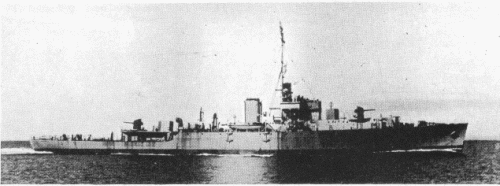
Burdekin 1946
Ships
| Name | No | Yard No | Builder | Laid down | Launched | Comp | Fate |
|---|---|---|---|---|---|---|---|
| Barcoo (RAN) | K375, 1948- F174 | 163 | Cockatoo DYd, Australia | 10.1942 | 26.8.1943 | 1.1944 | BU 2.1972 |
| Barwon (RAN) | K406, 1948- F402 | 164 | Cockatoo DYd, Australia | 5.1943 | 3.8.1944 | 1.1946 | BU 8.1962 |
| Burdekin (RAN) | K376, 1948- F403 | Walkers, Maryborough, Australia | 1.1942 | 30.6.1943 | 6.1944 | BU 9.1961 | |
| Diamantina (RAN) | K377, 1948- F377 | Walkers, Maryborough, Australia | 4.1943 | 6.4.1944 | 4.1945 | survey vessel 1959, preserved 2.1980 | |
| Gascoyne (RAN) | K354, 1948- F354 | Morts Dock, Sydney, Australia | 7.1942 | 20.2.1943 | 11.1943 | survey vessel 1959, BU 2.1972 | |
| Hawkesbury (RAN) | K363, 1948- F363 | Morts Dock, Sydney, Australia | 8.1942 | 24.7.1943 | 7.1944 | BU 2.1972 | |
| Lachlan (RAN) | K364, 1948- F364 | Morts Dock, Sydney, Australia | 3.1943 | 25.3.1944 | 2.1945 | to New Zealand 10.1949 (Lachlan), BU 2.1975 | |
| Macquarie (ex-Culgoa) (RAN) | K532, 1948- F532 | Morts Dock, Sydney, Australia | 12.1943 | 3.3.1945 | 12.1945 | BU 7.1972 |
Technical data
| Displacement standard, t | 1310 - 1460 |
|---|---|
| Displacement full, t | 1920 - 2180 |
| Length, m | 86.3 pp 91.8 oa |
| Breadth, m | 11.2 |
| Draught, m | 3.61 - 3.89 deep load |
| No of shafts | 2 |
| Machinery | 2 VTE, 2 Admiralty 3-drum boilers |
| Power, h. p. | 5500 |
| Max speed, kts | 20 |
| Fuel, t | oil 646 |
| Armament | Burdekin: 2 x 1 - 102/40 QF Mk XIX, 2 x 2 - 20/70 Oerlikon Mk II/IV, (2 - 4) x 1 - 20/70 Oerlikon Mk II/IV, 1 x 24 - 178 Hedgehog ASWRL, 8 DCT, 2 DCR (150) Barcoo, Gascoyne, Hawkesbury: 2 x 1 - 102/45 QF Mk XVI, 2 x 2 - 20/70 Oerlikon Mk II/IV, (2 - 4) x 1 - 20/70 Oerlikon Mk II/IV, 1 x 24 - 178 Hedgehog ASWRL, 8 DCT, 2 DCR (150) Barwon, Diamantina, Lachlan: 2 x 1 - 102/45 QF Mk XVI, (1 - 3) х 1 - 40/56 Bofors Mk III, 1 x 24 - 178 Hedgehog ASWRL, 8 DCT, 2 DCR (150) Macquarie: 1 x 2 - 102/45 QF Mk XVI HA, 2 x 3 - 305 Squid ASWRL, 8 DCT, 2 DCR (54) |
| Electronic equipment | type 271, A272 Mk II or SC-1 radars, type 144 sonar Macquarie: type 271, A272 Mk II or SC-1 radars, type 144, type 147 sonars |
| Complement | 140 |
Standard scale images
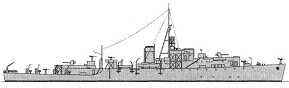
nearly sister-ship Jed 1944
Graphics
Burdekin 1946
Project history Design of "River" class frigate was developed in 1941 when it became clear, that for service in Atlantic escorts larger than "Flower" class c
Design of "River" class frigate was developed in 1941 when it became clear, that for service in Atlantic escorts larger than "Flower" class corvettes are required. Significantly increased dimensions have allowed to improve seaworthiness and habitability, to place additional armament and to fit twin-shaft machinery (actually doubled machinery of "Flower" class corvettes) and to increase speed to 20kts. Originally known as "twin-screw corvettes", "River" class ships, as well as their predecessors, created on merchant standards, but their hulls had lines more habitual for a warship, and L/B ratio has increased from 6 to 8. Thus the building technology, as well as corvettes, as much as possible adapted for usage on the yards which do not have experience of naval shipbuilding. Frigates were built also by Australia with a little differing from standard armament, consisting of two single 102mm. Later Australian ships had improved armament. Order for 10 units cancelled. Modernizations: 1944, Burdekin: - 2 x 1 - 102/40; + 2 x 1 - 102/45 QF Mk XVI
1945, Barcoo, Hawkesbury: - 2 x 1 - 102/45, 2 x 2 - 20/70, (2 - 4) x 1 - 20/70, 1 x 24 - 178 Hedgehog ASWRL; + 1 x 2 - 102/45 QF Mk XVI, 1 x 1 - 40/56 Bofors Mk III, 2 x 3 - 305 Squid ASWRL, type 275 radar, type 147 sonar. DC stowage was decreased to 54.
Naval service
Diamantina was preserved at Brisbane.
Many thanks to Wolfgang Stöhr for additional information on this page.