NAVYPEDIA
 Support the project with paypal
 HOME
HOME FIGHTING SHIPS OF THE WORLD
 UNITED KINGDOM
 ESCORTS
 CALDWELL ex-US destroyers (LEWES) (3, 1917 - 1918 / 1940)
Ships
| Name | No | Yard No | Builder | Laid down | Launched | Comp | Fate |
|---|---|---|---|---|---|---|---|
| Leeds (ex-Conner) | G27 | 436 | Cramp, Philadelphia, USA | 10/1916 | 21.8.1917 | 1/1918 // 10.1940 | BU 3.1947 |
| Lewes (ex-Conway, ex-Craven) | G68 | Norfolk N Yd, USA | 11.1917 | 29.6.1918 | 10.1918 // 10.1940 | sunk as target 25.5.1946 | |
| Ludlow (ex-Stockton) | G57 | 437 | Cramp, Philadelphia, USA | 10/1916 | 17.7.1917 | 11/1917 // 10.1940 | target 15.7.1945 |
Technical data
| Max speed, kts, kn | 30 |
|---|---|
| Displacement standard, t | 1120 |
| Displacement full, t | 1340 |
| Length, m | 94.5 wl 96.2 oa |
| Breadth, m | 9.30 |
| Draught, m | 2.70 |
| No of shafts | Leeds, Ludlow: 3 Lewes: 2 |
| Machinery | Leeds, Ludlow: 3 Parsons steam turbines / 1 Parsons geared steam turbine for cruising, 4 Thornycroft boilers Lewes: 2 sets Parsons geared steam turbines, 4 Thornycroft boilers |
| Power, h. p. | Leeds, Ludlow: 18500 Lewes: 20000 |
| Fuel, t | oil 290 |
| Endurance, nm(kts) | 4000(14) |
| Armament | 4 x 1 - 102/50 Mk 9, 1 x 1 - 76/23 Mk 14, 3 x 1 - 12.7/90, 4 x 3 - 533 TT, 2 DCR (10 - 15) |
| Electronic equipment | type 141 sonar |
| Complement | 146 |
Standard scale images
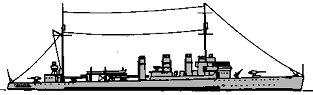
Stockton 1917
Project history
In May, 1940 Sir Winston Churchill has suggested US president Roosevelt to take for 99-year use all English naval and aviation bases in Western hemisphere, in exchange for 50 old destroyers. Originally the request has been turned down, however after the heavy losses suffered by Royal Navy in the summer of the same year, Churchill nevertheless managed to persuade Roosevelt, and 2.9.1940 president has signed the agreement. Transferred destroyers concerned to numerous class of "flushdeckers" built in the USA in 1917-1920. Their distinctive feature were flyshdecked hull silhouette, a rhombic arrangement of main guns and powerful torpedo armament. Ships were sectioned into some groups, differing by macinery structure, number of funnels and a fuel stowage. Transfer passed from September till November, 1940, part at once has arrived to RCN. Though Admiralty was in great need in the ships for escort of Atlantic convoys, destroyers received from the USA needed many modernizing works to use them in this role. Armament of "flushdeckers" has not undergone some serious changes in 20 years of service and suited for the anti-air and anti-submarine tasks a little. Besides, insufficient, from the point of view of Admiralty, stability of ships demanded acceptance of measures for decrease of the top weight. As a whole update of former American destroyers repeated update to which have undergone in 1940 on old British WWI-era destroyers: British-constructed sonar was fitted, aft 102mm main gun was changed by 3'' AA, and short gun of the same calibre was removed, as well as pair of TT mounts. 4 DCTs were installed (rarely 2).
Modernizations
late 1940, all: - 1 x 1 - 102/50, 1 x 1 - 76/23, 2 x 3 - 533 TT; + 1 x 1 - 76/50 Mk 10.19/20, 4 DCT, DC stowage increased up to 60
1941-1942, most: + type 271, type 286 radars
1941 - 1942, Leeds: - 2 x 1 - 102/50, 2 x 3 - 533 TT; + 2 x 1 - 76/50 Mk 10.19/20, 2 x 1 - 20/70 Oerlikon Mk II/IV
1941 - 1942, Lewes, Ludlow: - 3 x 1 - 102/50, 2 x 3 - 533 TT: + 2 x 1 - 76/50 Mk 10.19/20, 2 x 1 - 40/39 2pdr QF Mk VIII, 2 x 1 - 20/70 Oerlikon Mk II/IV
1943-1944, some: - type 286 radar; + type 291 radar
1943 - 1944, Leeds: - 1 x 1 - 102/50, 3 x 1 - 76/50; + 3 x 1 - 20/70 Oerlikon Mk II/IV
1943 - 1944, Lewes, Ludlow: - 3 x 1 - 76/50; + 3 x 1 - 20/70 Oerlikon Mk II/IV
1/1946, Lewes: 2 x 1 - 40/39 Mk VIII, 5 x 1 - 20/70 Mk III, 4 DCT, 2 DCR (60), type 271, type 286 or type 291 radars, type 141 sonar
1/1946, Leeds: 5 x 1 - 20/70 Mk III, 4 DCT, 2 DCR (60), type 271, type 286 or type 291 radars, type 141 sonar
Naval service
No significant events.
Many thanks to Wolfgang Stöhr for additional information on this page.