NAVYPEDIA
 Support the project with paypal
 HOME
HOME FIGHTING SHIPS OF THE WORLD
 UNITED KINGDOM
 TORPEDO SHIPS
 Tribal type destroyers (AFRIDI) (27, 1938 - 1948)
Photo
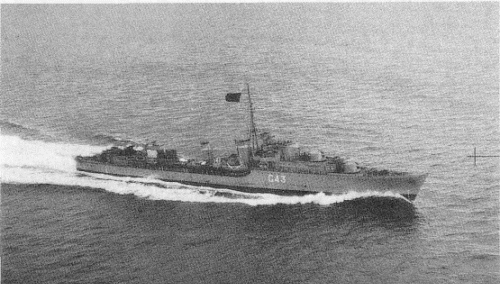
Tartar 1941
Ships
| Name | No | Yard No | Builder | Laid down | Launched | Comp | Fate | Modification |
|---|---|---|---|---|---|---|---|---|
| Afridi | F07 | Vickers-Armstrong, Tyne | 6/1936 | 8.6.1937 | 5.1938 | sunk 3.5.1940 | RN "Tribals" | |
| Ashanti | F51, G51, 1948- D151? | Denny, Dumbarton | 11.1936 | 5.11.1937 | 12.1938 | BU 4.1949 | RN "Tribals" | |
| Bedouin | F67, G67 | Denny, Dumbarton | 6.1937 | 21.12.1937 | 3.1939 | sunk 15.6.1942 | RN "Tribals" | |
| Cossack | F03, L03 | Vickers-Armstrong, Tyne | 6.1936 | 8.6.1937 | 6.1938 | sunk 27.10.1941 | RN "Tribals" | |
| Eskimo | F75, G75, 1948- D175? | Vickers-Armstrong, Tyne | 8.1936 | 3.9.1937 | 12.1938 | BU 6.1949 | RN "Tribals" | |
| Gurkha | F20 | Fairfield, Govan | 7.1936 | 7.7.1937 | 10.1938 | sunk 9.4.1940 | RN "Tribals" | |
| Maori | F24 | Fairfield, Govan | 7.1936 | 2.9.1937 | 1.1939 | sunk 12.2.1942 | RN "Tribals" | |
| Mashona | F59 | Vickers-Armstrong, Tyne | 8.1936 | 3.9.1937 | 3.1939 | sunk 28.5.1941 | RN "Tribals" | |
| Matabele | F26 | Scotts, Greenock | 10.1936 | 6.10.1937 | 1.1939 | sunk 17.1.1942 | RN "Tribals" | |
| Mohawk | F31, L31 | Thornycroft, Woolston | 7.1936 | 5.10.1937 | 9.1938 | sunk 16.4.1941 | RN "Tribals" | |
| Nubian | F36, G36, 1948- D236? | Thornycroft, Woolston | 8.1936 | 21.12.1937 | 12.1938 | BU 6.1949 | RN "Tribals" | |
| Punjabi | F21, G21 | Scotts, Greenock | 10.1936 | 18.12.1937 | 3.1939 | collision 1.5.1942 | RN "Tribals" | |
| Sikh | F82 | A. Stephens, Linthouse | 9.1936 | 17.12.1937 | 10.1938 | sunk 14.9.1942 | RN "Tribals" | |
| Somali | F33 | Swan Hunter, Wallsend | 8.1936 | 24.8.1937 | 12.1938 | sunk 24.9.1942 | RN "Tribals" | |
| Tartar | F43, G43 | Swan Hunter, Wallsend | 8.1936 | 21.10.1937 | 3.1939 | BU 1.1948 | RN "Tribals" | |
| Zulu | F18, G18 | A. Stephens, Linthouse | 8.1936 | 23.9.1937 | 9.1938 | sunk 14.9.1942 | RN "Tribals" | |
| Arunta (RAN) | I30, 1948- D130 | Cockatoo DYd, Australia | 11.1939 | 30.11.1940 | 3.1942 | sold for BU 11.1968 | RAN "Tribals" | |
| Bataan (RAN) | I91, 1948- D191 | Cockatoo DYd, Australia | 2.1942 | 15.1.1944 | 5.1945 | BU 5.1958 | RAN "Tribals" | |
| Warramunga (RAN) | I44, 1948- D123 | Cockatoo DYd, Australia | 2.1940 | 6.2.1942 | 11.1942 | BU 2.1963 | RAN "Tribals" | |
| Athabaskan (RCN) | G07 | Vickers-Armstrong, Tyne | 10.1940 | 18.11.1941 | 2.1943 | sunk 29.4.1944 | RCN "Tribals" | |
| Haida (RCN) | G63, 1948- D63?, 1951- DDE215 | Vickers-Armstrong, Tyne | 9.1941 | 25.8.1942 | 9.1943 | preserved 8.1964 | RCN "Tribals" | |
| Huron (RCN) | G24, 1948- D124?, 1951- DDE216 | Vickers-Armstrong, Tyne | 7.1941 | 25.6.1942 | 7.1943 | BU 8.1965 | RCN "Tribals" | |
| Iroquois (RCN) | G89, 1948- D89?, 1951- DDE217 | Vickers-Armstrong, Tyne | 9.1940 | 23.9.1941 | 12.1942 | BU 9.1966 | RCN "Tribals" | |
| Athabaskan (RCN) | R79, 1948- D179?, 1951- DDE219 | Halifax, Canada | 5.1944 | 14.5.1946 | 1.1948 | BU 7.1969 | RCN "Tribals" | |
| Cayuga (RCN) | R04, 1948- D104?, 1951- DDE218 | Halifax, Canada | 10.1943 | 28.7.1945 | 10.1947 | BU 2.1964 | RCN "Tribals" | |
| Micmac (RCN) | R10, 1948- D110?, 1951- DDE214 | Halifax, Canada | 5.1942 | 18.9.1943 | 9.1945 | BU 3.1964 | RCN "Tribals" | |
| Nootka (RCN) | R96, 1948- D96?, 1951- DDE213 | Halifax, Canada | 5.1942 | 26.4.1944 | 8.1946 | BU 10.1964 | RCN "Tribals" |
Technical data
| Max speed, kts, kn | 36.25 - 36.5 |
36.25 |
|---|---|---|
| Data variant | as completed | Canadian ships modernization 1951-55 |
| Displacement standard, t | 1959 Canadian: 1927 |
2200 |
| Displacement full, t | 2519 (later 2710) Canadian: 2745 |
2500 |
| Length, m | 108.4 pp 114.9 oa |
108.4 pp 114.9 oa |
| Breadth, m | 11.1 Canadian: 11.4 |
11.4 |
| Draught, m | 3.96 (later 4.16) |
4.16 |
| No of shafts | 2 |
2 |
| Machinery | 2 sets Parsons geared steam turbines, 3 Admiralty 3-drum boilers |
2 sets Parsons geared steam turbines, 3 Admiralty 3-drum boilers |
| Power, h. p. | 44000 |
44000 |
| Fuel, t | oil 505 - 516 |
oil 505 - 516 |
| Endurance, nm(kts) | 5700(15) | |
| Armament | RN ships: 4 x 2 - 120/45 QF Mk XII, 1 x 4 - 40/39 2pdr QF Mk VIII, 2 x 4 - 12.7/62, 1 x 4 - 533 TT, 2 DCT, 1 DCR (30 DC) Arunta, Waramunga: 3 x 2 - 120/45 QF Mk XII, 1 x 2 - 102/45 QF Mk XVI, 1 x 4 - 40/39 2pdr QF Mk VIII, 6 x 1 - 20/70 Oerlikon Mk II/IV, 1 x 4 - 533 TT, 2 DCT, 2 DCR (30 DC) Bataan: 3 x 2 - 120/45 QF Mk XII, 1 x 2 - 102/45 QF Mk XVI, 6 x 1 - 40/56 Bofors Mk III, 1 x 4 - 40/39 2pdr QF Mk VIII, 1 x 4 - 533 TT, 2 DCT, 2 DCR (46 DC) Iroquois: 3 x 2 - 120/45 QF Mk XII, 1 x 2 - 102/45 QF Mk XVI, 1 x 4 - 40/39 2pdr QF Mk VIII, 6 x 1 - 20/70 Oerlikon Mk II/IV, 1 x 4 - 533 TT, 2 DCT, 1 DCR (30 DC) Athabaskan (I): 3 x 2 - 120/45 QF Mk XII, 1 x 2 - 102/45 QF Mk XVI, 1 x 4 - 40/39 2pdr QF Mk VIII, 4 x 2 - 20/70 Oerlikon Mk II/IV, 2 x 1 - 20/70 Oerlikon Mk II/IV, 1 x 4 - 533 TT, 2 DCT, 1 DCR (30 DC) Huron, Haida: 3 x 2 - 120/45 QF Mk XII, 1 x 2 - 102/45 QF Mk XVI, 1 x 4 - 40/39 2pdr QF Mk VIII, 6 x 2 - 20/70 Oerlikon Mk II/IV, 1 x 4 - 533 TT, 2 DCT, 1 DCR (30 DC) Athabaskan (II), Cayuga: 4 x 2 - 102/45 QF Mk XVI, 1 x 2 - 40/56 Bofors Mk VIII/IX, 2 x 1 - 40/56 Bofors Mk III, 2 x 2 - 20/70 Oerlikon Mk II/IV, 1 x 4 - 533 TT, 2 DCT, 2 DCR (46 DC) Micmac, Nootka: 4 x 2 - 102/45 QF Mk XVI, 2 x 2 - 40/56 Bofors Mk VIII/IX, 2 x 1 - 40/56 Bofors Mk III, 2 x 2 - 20/70 Oerlikon Mk II/IV, 1 x 4 - 533 TT |
2 x 2 - 102/45 Mk 19, 1 x 2 - 76/50 Mk 22, 4 x 1 - 40/60 Boffin, 1 x 4 - 533 TT, 2 x 3 - 305 Squid Mk 3 ASWRL Cayuga, Athabaskan: 2 x 2 - 102/45 Mk 19, 1 x 2 - 76/50 Mk 22, 4 x 1 - 40/60 Mk 7, 1 x 4 - 533 TT, 2 x 3 - 305 Squid Mk 3 ASWRL |
| Electronic equipment | RN ships: type 124 sonar presumably Arunta, Warramunga: type 285, type 286 radars, type 144 sonar presumably Iroquois, Athabscan (I): type 271, type 272, type 285, type 291 radars, type 144 sonar presumably Huron, Haida: type 271, type 285, type 291 radars, type 144 sonar presumably Bataan: type 272, type 275, type 291 radars, type 144 sonar presumably Micmac, Nootka: type 268, type 275, type 277, type 282, type 291 radars, type 144 sonar presumably Cayuga, Athabascan (II): type 262, type 268, type 275, type 277, type 291 radars, type 144 sonar |
SPS-10, SPS-6, Mk 28, type 293, type 262 radars, type 170, type 174 sonars Cayuga, Athabaskan: type 275, type 293, type 262, type 268, type 277 radars, type 170, type 174 sonars |
| Complement | 190 - 250 |
240 |
Standard scale images
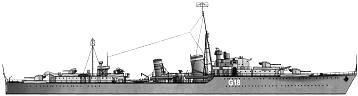
Zulu 1941
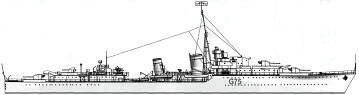
Eskimo 1942
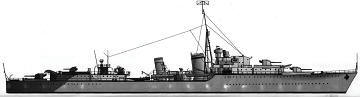
Sikh 1942
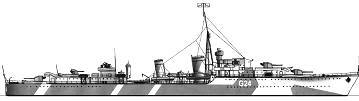
Huron 1944
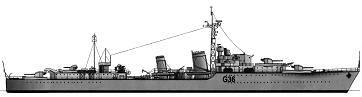
Nubian 1945
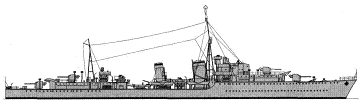
Eskimo 1939
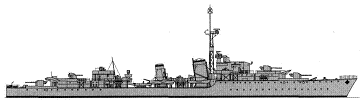
Athabascan 1943
Graphics
Tartar 1941
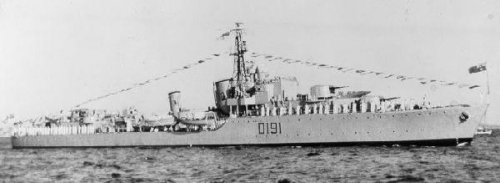
Bataan
Project history
"Tribal" class ships became the answer of Britain to occurrence in navies of probable opponents of large destroyers appreciable exceeding on armament standard British destroyers with their four 120mm guns. A starting point in designing of the new ship began requirement of Admiralty to place powerful armament including ten 120mm guns that should ensure the superiority over new foreign destroyers, such as Japanese Fubuki (3x2 127mm guns and 3х3 TT). Besides it, the wish to ensure leaders of "V" class (an initial designation of these ships) the strengthened air defence armament including newest multi-barrelled 40-mm pompoms expressed. Thus especially made a reservation, that the ships should not be so large that require armour protection, but to have the sufficient dimensions for providing of good seaworthiness.
By basic design working out it has appeared what to fulfil all requirements within the limits of the resolved displacement (1850t was an upper limit for leaders according to decisions of the London conference) is impossible, and after considering of numerous variants were stopped on the design with 8 120mm guns, two quadruple 40mm pompoms (one was excluded from the specification already after the bulding beginning) and 1 quadruple TT (the truth, with a power drive). It was supposed, that the ships of this class will be brought together in a flotilla of seven-ships structure, and under the 1935 Programme building of such flotilla was provided, but this idea have soon refused, having ordered next year not 7, but 9 ships.
Structurally, except transition to heavier twin main gun mounts, application of yacht stem instead of straight one (as planned on sketch design phases on "Tribal") and using of 30% more powerful machinery, "Tribal" essentially did not differ from the predecessors: the same internal arrangement and the same traditional framing. Lastter also became the main lack of these in remaining very successful ships.
Dominions also have replenished with "Tribal" class ships. Australians have decided to built them by own strength, but with assistance of British specialists, and machinery have been ordered in Britain. Australian "Tribals" originally differed nothing from an British prototypes. First two ships have ordered in the January, 1939, four more in May of the same year. Order for 3 additional units was cancelled before a war. Already during a building structure of armament of the ships have made the changes dictated by experience of the first months of operations in Europe. Basically they repeated works conducted on British "Tribals": in particular, "X" 120mm mount and 12.7mm MGs were replaced by DP 102mm twin and 20mm Oerlikons. Bataan was completed the last and carried 40mm/56 Boforses instead of Oerlikons.
Decision on a building of "Tribals" was accepted also by Canada in 1940, but not at itself, and in British. In 1940 the order on 4 ships has been given out. During building armament was changed in general repeating accepted on the Australian destroyers. More successful arranging of quadruple pompom became unique significant difference. Already after an end of the war 4 more Canadian "Tribal" class destroyers were completed, built in Canada under a little changed design (4x2 102-mm/45 guns and 40mm Boforses).
Modernizations
summer 1940, Ashanti, Bedouin, Cossack, Eskimo, Maori, Mashona, Matabele, Mohawk, Nubian, Punjabi, Sikh, Somali, Tartar, Zulu: - 1 x 2 - 120/45; + 1 x 2 - 102/45 QF Mk XVI
early 1941, Ashanti, Bedouin, Cossack, Eskimo, Maori, Mashona, Matabele, Mohawk, Nubian, Punjabi, Somali, Tartar: + 2 x 1 - 20/70 Oerlikon Mk II/IV
early 1941, Sikh, Zulu: + 2 x 1 - 40/39 2pdr QF Mk VIII
1941 - 1942, almost all survived RN ships: + type 271 type 285, type 286/M/P radars
1942, Ashanti, Bedouin, Eskimo, Nubian, Punjabi, Sikh, Somali, Tartar, Zulu: - 2 x 4 - 12.7/62; + 2 x 1 - 20/70 Oerlikon Mk II/IV, DC stowage rose up to 46 pcs.
1943 - 1944, Ashanti, Eskimo, Tartar: - 2 x 1 - 20/70; + 4 x 2 - 20/70 Oerlikon Mk II/IV
1943 - 1944, Iroquois: - 6 x 1 - 20/70; + 6 x 2 - 20/70 Oerlikon Mk II/IV
1943 - 1944, most RN ships: - type 286/M/P radar; + type 291 radar
1944, Nubian: + 2 x 1 - 40/56 Bofors Mk I/III, 2 x 2 - 20/70 Oerlikon Mk II/IV
1944 - 1945, some RN ships: - type 271 radar; + type 293 radar
1944 - 1945, Arunta, Warramunga: - 6 x 1 - 20/70; + 6 x 1 - 40/56 Bofors Mk III
1/1946, Ashanti: 3 x 2 - 120/45 CP Mk XIX, 1 x 2 - 102/45 Mk XIX, 1 x 4 - 40/39 Mk VII, 4 x 2 - 20/70 Mk V, 2 x 1 - 20/70 Mk III, 1 x 4 - 533 TT, 2 DCT, 1 DCR (46), type 285, type 291, type 271 or type 293 radars, type 124 sonar
1/1946, Eskimo: 3 x 2 - 120/45 CP Mk XIX, 1 x 2 - 102/45 Mk XIX, 1 x 4 - 40/39 Mk VII, 4 x 2 - 20/70 Mk V, 2 x 1 - 20/70 Mk III, 1 x 4 - 533 TT, 2 DCT, 1 DCR (46), type 285, type 291, type 271 or type 293 radars, type 124 sonar
1/1946, Nubian: 3 x 2 - 120/45 CP Mk XIX, 1 x 2 - 102/45 Mk XIX, 1 x 4 - 40/39 Mk VII, 2 x 1 - 40/60 Mk III, 2 x 2 - 20/70 Mk V, 4 x 1 - 20/70 Mk III, 1 x 4 - 533 TT, 2 DCT, 1 DCR (46), type 285, type 291, type 271 or type 293 radars, type 124 sonar
1/1946, Tartar: 3 x 2 - 120/45 CP Mk XIX, 1 x 2 - 102/45 Mk XIX, 1 x 4 - 40/39 Mk VII, 4 x 2 - 20/70 Mk V, 2 x 1 - 20/70 Mk III, 1 x 4 - 533 TT, 2 DCT, 1 DCR (46), type 285, type 291, type 271 or type 293 radars, type 124 sonar
1946 - 1951, Iroquois, Huron, Haida: - 3 x 2 - 120/45, 1 x 4 - 40/39, 6 x 2 - 20/70, 2 DCT, 1 DCR, type 275 or type 285 radar; + 3 x 2 - 102/45 Mk XIX, 1 x 2 - 40/60 Mk V, 2 x 1 - 40/60 Mk VII, 1 x 3 - 305 Squid Mk 3 ASWRL, Mk 28 radar, type 147 sonar
1951 - 1955, all survived Canadian ships were modernized as follows:
1953, Arunta; 1954, Warramunga: new lattice mast, superstructure was lengthened. - 1 x 2 - 120/45, 4 x 1 - 40/60, 1 x 4 - 40/39; + 1 x 2 - 40/60 Mk 5, 1 x 3 - 305 Squid Mk 3 ASWRL, type 174 sonar
Naval service
Afridy 3.5.1940 was sunk by German Ju 87 bomber W of Namsus (Norway). Ashanti 17.10.1940 was wrecked by a storm on rocks at Sunderland coast (England), repair lasted till the end of August, 1941. Bedouin 15.6.1942 was badly damaged by 152mm shells from Italian cruisers Eugenio di Savoia Duca degli Abruzzi and Raimondo Montecuccoli S of Pantelleria Island , later she was finished by Italian S.79 bomber (torpedo). Cossack 13.4.1940 was seriously damaged by hits of four 127mm shells from German destroyers and as a result of beaching in harbour of Narvik, repaired till August, 1940; 23.10.1941 she was badly damaged by German submarine U563 W of Gibraltar, 27.10.1941 sunk. Eskimo 13.4.1940 was badly damaged by hit of torpedo from German destroyer Georg Thiele (fore hull part was broken off), repair lasted till September, 1940. Gurkha 9.4.1940 was sunk by German Ju 88 bomber W of Bergen. Maori was sunk by German Ju 88 bomber 12.2.1942 off Malta. Mashona was sunk by German Ju 88 bomber SW of Ireland 28.5.1941. Matabele in the end of May, 1940 was damaged by German aircraft at coast of Northern Norway, repair lasted till the middle of August, 1940; she was sunk by German submarine U454 in Barents Sea 17.1.1942. Mohawk was torpedoed by Italian destroyer Luca Tarigo 16.4.1941 off Cape Bon and finished by gunfire of destroyer Janus. Punjabi was damaged by 127mm shells from German destroyers Giese and Roeder, repaired till June, 1940; she was lost in collision with battleship King George V in Northern Atlantic 1.5.1942. Sikh was sunk by German coastal battery at Tobruk 14.9.1942. Somali was damaged by a torpedo from German submarine U703 S of Iceland 20.9.1942 and foundered under tow 24.9.1942. Zulu was damaged by German Ju 88 bomber at Tobruk and sunk 14.9.1942 under tow. Athabaskan 29.4.1944 was torpedoed by German torpedo boat Т24 N of Ile de Bas (La Manche), blown up and sunk.
Haida was preserved as memorial in Toronto. Arunta was foundered under tow to Japan for scrap 13.2.1969.