NAVYPEDIA
 Support the project with paypal
 HOME
HOME FIGHTING SHIPS OF THE WORLD
 UNITED KINGDOM
 CRUISERS
 KENT heavy cruisers (7, 1928)
Photo
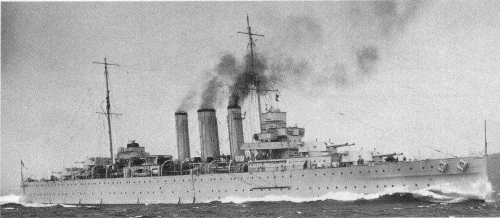
Canberra 1928
Ships
| Name | No | Yard No | Builder | Laid down | Launched | Comp | Fate |
|---|---|---|---|---|---|---|---|
| Berwick | 65 | 616 | Fairfield, Govan | 15.9.1924 | 30.3.1926 | 15.2.1928 | sold for BU 1948 |
| Cornwall | 56 | Devonport DYd | 9.10.1924 | 11.3.1926 | 8.5.1928 | sunk 5.4.1942 | |
| Cumberland | 57, 1948- C57 | 618 | Vickers-Armstrong, Barrow | 18.10.1924 | 16.3.1926 | 23.1.1928 | sold for BU 1959 |
| Kent | 54 | Chatham DYd | 15.11.1924 | 16.3.1926 | 22.6.1928 | sold for BU 1948 | |
| Suffolk | 55 | Portsmouth DYd | 30.9.1924 | 16.2.1926 | 31.5.1928 | sold for BU 1948 | |
| Australia (RAN) | I84, D84, 1948- C01 | 512 | John Brown, Clydebank | 26.8.1925 | 17.3.1927 | 24.4.1928 | sold for BU 1955 |
| Canberra (RAN) | I33, D33 | 513 | John Brown, Clydebank | 9.9.1925 | 31.5.1927 | 10.7.1928 | sunk 9.8.1942 |
Technical data
| Max speed, kts, kn | 31.5 |
|---|---|
| Displacement standard, t | 9750 - 9870 (about 10900 finally) |
| Displacement full, t | 13400 - 13540 (14490 - 14910 finally) |
| Length, m | 179.8 pp 192.0 - 192.9 oa |
| Breadth, m | 20.8 |
| Draught, m | 6.25 deep load (6.71 - 6.88 finally) |
| No of shafts | 4 |
| Machinery | 4 sets Parsons geared steam turbines, 8 Admiralty 3-drum boilers Berwick, Australia, Canberra: 4 sets Brown-Curtis geared steam turbines, 8 Admiralty 3-drum boilers |
| Power, h. p. | 80000 |
| Fuel, t | oil 3200 - 3400 |
| Endurance, nm(kts) | 13300(12) |
| Armour, mm | box protection to magazines: 111 - 25, belt: 25, bulkheads: 25, barbettes: 25, turrets: 25, deck: 38 - 25 |
| Armament | 4 x 2 - 203/50 Mk VIII, 4 x 1 - 102/45 QF Mk V, 4 x 1 - 47/40 Hotchkiss Mk I, 4 x 1 - 40/39 2pdr QF Mk II, 2 x 4 - 533 TT |
| Complement | 685 - 710 |
Standard scale images
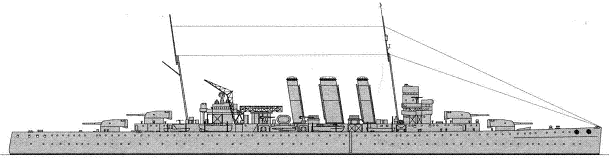
Canberra 1940
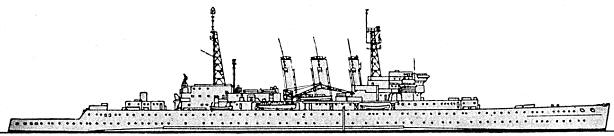
Cumberland 1954
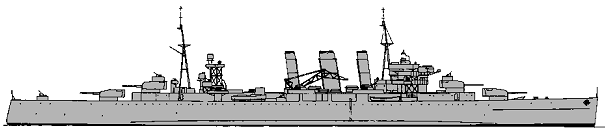
Kent 1944
Graphics
Canberra 1928
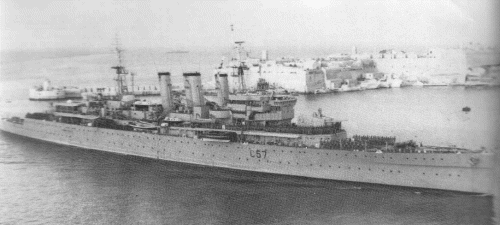
Cumberland 1958
Project history
First British cruisers designed according to limitations of Washington conference (10 000t standard displacement, 203mm main guns). In comparison with the similar ships of other navies they were not so fast and protected however possessed the big endurance and good seaworthiness. They were intended, first of all, for protection of sea communications and hunting for raiders, instead of operations with main forces. Five ships were built by 1925 Programme. Two more ships were ordered by Australia.
Hull form in the cross-section plan resembled the one accepted on last battlecruisers of Royal Navy (Courageous and Hood): above the waterline it was trapezoidal, transferred to blisters below. Ships had original box-shaped armour protection concentrated around the vital places. Main guns had 70° maximal elevation angle.
In 1934 the design of modernization of class was ready. According to it it was supposed to equip them with narrow armoured belt on waterline.
Protection
Underwater protection (bulges) was 1.6m in deep on British and 0.76m on Australian ships. Magazines were protected by 111 (102mm armour on 9mm plating)-25mm sides and 76-25mm platform deck. Machinery was protected by 25mm bulkheads and 32mm deck. Steering gear had 38-25mm horizontal protection.
Modernizations
1931 - 1932, British ships: + 1 catapult S-II-L, 1 Flycatcher (later Osprey) seaplane
1933, Kent: + 2 x 1 - 102/45 QF Mk V
1934, all: + 2 x 4 - 12.7/62
1935, Australia: + 1 catapult S-II-L, 1 Osprey seaplane
7/1936, Cumberland: new 114mm belt 1.8m in height abreast machinery and transmitting station was fitted. 102mm internal plating was added to the sides of boiler room fan compartments. One deck was cut down abaft "Y" turret. New catapult D-II-H and 2 hangars for Walrus seaplanes were fitted; - 2 x 1 - 102/45, 4 x 1 - 40/39, 2 x 4 - 533 TT; + 2 x 2 - 102/45 QF Mk XVII, 2 x 4 - 40/39 2pdr QF Mk VIII, (2 seaplanes instead of 1)
1937, Suffolk: new 114mm belt 1.8m in height abreast machinery and transmitting station was fitted. 102mm internal plating was added to the sides of boiler room fan compartments. One deck was cut down abaft "Y" turret. New catapult D-II-H and 2 hangars for Walrus seaplanes were fitted; - 4 x 1 - 102/45, 4 x 1 - 40/39, 2 x 4 - 533 TT; + 3 x 2 - 102/45 QF Mk XVII, 2 x 4 - 40/39 2pdr QF Mk VIII, (2 seaplanes instead of 1)
1937 - 1939, Berwick, Cornwall: new 114mm belt 1.8m in height abreast machinery and transmitting station was fitted. 102mm internal plating was added to the sides of boiler room fan compartments. New catapult D-II-H and 2 hangars for Walrus seaplanes were fitted; - 4 x 1 - 102/45, 4 x 1 - 40/39, 2 x 4 - 533 TT; + 4 x 2 - 102/45 QF Mk XVI, 2 x 8 - 40/39 2pdr QF Mk VIII, (2 seaplanes instead of 1)
1938, Kent: new 114mm belt 1.8m in height abreast machinery and transmitting station was fitted. 102mm internal plating was added to the sides of boiler room fan compartments. New catapult E-IV-H for Walrus seaplane was fitted. - 6 x 1 - 102/45, 4 x 1 - 40/39; + 4 x 2 - 102/45 QF Mk XVI, 2 x 8 - 40/39 2pdr QF Mk VIII
1935 - 1939, Australia: new 114mm belt 1.8m in height abreast machinery and transmitting station was fitted. 102mm internal plating was added to the sides of boiler room fan compartments. New catapult E-IV-H for Walrus seaplane was fitted; + 1 x 4 - 40/39 2pdr QF Mk VIII
1938, Cumberland: - 2 x 2 - 102/45, 2 x 1 - 102/45; + 4 x 2 - 102/45 QF Mk XVI
1939, all: - 4 x 1 - 47/40
1939, Suffolk: + type 79Z radar
late 1940, Suffolk: - type 79Z radar; + type 279, type 284, type 285 radars
12/1940, Australia: - 4 x 1 - 102/45, 2 x 4 - 533 TT; + 4 x 2 - 102/45 QF Mk XVI, type 286 radar
early 1941, Canberra: + 4 x 1 - 102/45 QF Mk V, radar
2/1941, Suffolk: - 3 x 2 - 102/45; + 4 x 2 - 102/45 QF Mk XVI, 4 x 1 - 20/70 Oerlikon Mk II/IV
6/1941, Berwick: + type 279, type 284, type 286M radars
9/1941, Kent: + 6 x 1 - 20/70 Oerlikon Mk II/IV, type 281, type 284, type 285 radars
10/1941, Berwick: + 5 x 1 - 20/70 Oerlikon Mk II/IV
10/1941, Cumberland: + 5 x 1 - 20/70 Oerlikon Mk II/IV, type 273, type 281, type 285 radars
6/1942, Suffolk: - 2 x 4 - 12.7/62, type 279 radar; + 4 x 1 - 20/70 Oerlikon Mk II/IV, type 273, type 281 radars
6/1942, Canberra: - 4 x 1 - 40/39; + 2 x 8 - 4.39 2pdr QF Mk VIII, 5 x 1 - 20/70 Oerlikon Mk II/IV
8/1942, Berwick: - catapult and seaplanes, 2 x 4 - 12.7/62; + 6 x 1 - 20/70 Oerlikon Mk II/IV, type 273, 4x type 283 radars
10/1942, Australia: - 1 x 4 - 40/39; + 2 x 8 - 40/39 2pdr QF Mk VIII
11/1942, Kent: - catapult and seaplanes, 2 x 4 - 12.7/62; + 6 x 1 - 20/70 Oerlikon Mk II/IV, type 273 radar
2/1943, Cumberland: - 1 x 1 - 20/70, 2 x 4 - 12.7/62; + 5 x 2 - 20/70 Oerlikon Mk II/IV, type 282 radar
2/1943, Suffolk: - catapult and seaplanes, 2 x 4 - 40/39, 5 x 1 - 20/70; + 2 x 8 - 40/39 2pdr QF Mk VIII, 5 x 2 - 20/70 Oerlikon Mk II/IV, type 282 radar
9/1943, Kent: - 6 x 1 - 20/70; + 3 x 2 - 20/70 Oerlikon Mk II/IV, 4x type 283 radars
10/1943, Berwick: - 2 x 8 - 40/39, 7 x 1 - 20/70, type 279 radar; + 2 x 4 - 40/39 2pdr QF Mk VIII, 7 x 2 - 20/70 Oerlikon Mk II/IV, type 281B, 2x type 282, type 285 radars
late 1943, Australia: - 4 x 1 - 40/39, 2 x 4 - 12.7/62, type 286 radar; + 7 x 1 - 20/70 Oerlikon Mk II/IV, type 273, type 281 radars
3/1944, Australia: - catapult and seaplanes, 7 x 1 - 20/70; + 7 x 2 - 20/70 Oerlikon Mk II/IV
4/1944, Suffolk: + 3 x 1 - 20/70 Oerlikon Mk II/IV
2/1945, Australia: - 1 x 2 - 203/50; + 2 x 8 - 40/39 2pdr QF Mk VIII, 2 x 4 - 40/56 Bofors Mk 1.2, 2 x 2 - 40/56 Bofors Mk 1.2, 2 x 1 - 40/56 Bofors Mk 1.2, type 284, type 285 radars
late 1945, Cumberland: + 2 x 1 - 20/70 Oerlikon Mk II/IV
late 1945, Australia: - 7 x 2 - 20/70
1.1946, Berwick: 4 x 2 - 203/50 Mk I, 4 x 2 - 102/45 Mk XIX, 2 x 4 - 40/39 Mk VII, 7 x 2 - 20/70 Mk V, 4 x 1 - 20/70 Mk III, type 273, type 281B, 2x type 282, 4x type 283, type 284, type 285, type 286M radars
1.1946, Cumberland: 4 x 2 - 203/50 Mk I, 4 x 2 - 102/45 Mk XIX, 2 x 4 - 40/39 Mk VII, 5 x 2 - 20/70 Mk V, 6 x 1 - 20/70 Mk III, 1 catapult, 2 seaplanes, type 273, type 281, type 282, type 285 radars
1.1946, Kent: 4 x 2 - 203/50 Mk I, 4 x 2 - 102/45 Mk XIX, 2 x 8 - 40/39 Mk VIA, 3 x 2 - 20/70 Mk V, 6 x 1 - 20/70 Mk III, 2 x 4 - 533 TT, type 273, type 281, 4x type 283, type 284, type 285 radars
1.1946, Suffolk: 4 x 2 - 203/50 Mk I, 4 x 2 - 102/45 Mk XIX, 2 x 8 - 40/39 Mk VIA, 5 x 2 - 20/70 Mk V, 6 x 1 - 20/70 Mk III, type 273, type 281, type 282, type 284, type 285 radars
Naval service
Suffolk was damaged by direct hit of 1000kg bomb 17.4.1940 and repaired 10 months. Kent 17.9.1940 was damaged by air torpedo and repaired one year. Cornwall was sunk by the Japanese carrier aircraft (D3A1 divng bombers from Akagi, Hiryu and Soryu) S of Ceylon 5.4.1942 (9 direct bomb hits). Canberra was demolished by gunfire of Japanese cruisers Chokai, Aoba, Kako, Furutaka and Kinugasa in battle off Savo 9.8.1942 and sunk in 7 hours.
In 1949 - 1951 Cumberland was converted to test ship. New lattice foremast and new sensors were fitted. Ship was rearmed and carried various armament for test. One (later 2) single 114/45mm , twin 40/60mm Bofors STAAG were mounted in various times. The ship had 1 twin 76/70mm Mk 6 mounting from 1953 and additionally 1 twin 152/50mm automatic Mk 26 later.
Many thanks to Wolfgang Stöhr for additional information on this page.