NAVYPEDIA
 Support the project with paypal
 HOME
HOME FIGHTING SHIPS OF THE WORLD
 UNITED KINGDOM
 CRUISERS
 CALEDON light cruisers (4, 1917)
Photo
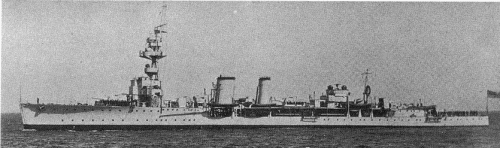
Calypso 1919
Ships
| Name | No | Yard No | Builder | Laid down | Launched | Comp | Fate |
|---|---|---|---|---|---|---|---|
| Caledon | 69, 22, 65,D53 | 828 | Cammell Laird, Birkenhead | 17.3.1916 | 25.11.1916 | 3.1917 | sold for BU 1.1948 |
| Cassandra | 3C, 32, 04 | 456 | Vickers, Barrow | 3.1916 | 25.11.1916 | 6.1917 | sunk 5.12.1918 |
| Caradoc | A0, 28, 55, D60 | 476 | Scotts, Greenock | 21.2.1916 | 23.12.1916 | 6.1917 | sold for BU 4.1946 |
| Calypso | 24, 82, D61 | 486 | Hawthorn Leslie, Hebburn | 7.2.1916 | 24.1.1917 | 6.1917 | sunk 12.6.1940 |
Technical data
| Displacement normal, t | 4120 |
|---|---|
| Displacement full, t | 4950 |
| Length, m | 137.2 |
| Breadth, m | 13.0 |
| Draught, m | 5.00 |
| No of shafts | 2 |
| Machinery | 2 sets Parsons geared steam turbines, 6 Yarrow boilers |
| Power, h. p. | 40000 |
| Max speed, kts | 29 |
| Fuel, t | oil 935 |
| Endurance, nm(kts) | 5900(10) |
| Armour, mm | belt: 76 - 32, deck: 25, CT: 152, gun shields: 25 |
| Armament | Caledon, Cassandra: 5 x 1 - 152/45 BL Mk XII, 2 x 1 - 76/45 20cwt QF Mk I, 4 x 1 - 47/40 3pdr Hotchkiss Mk I, 4 x 2 - 533 TT, flying-off platform, 1 aircraft (Pup) Calypso, Caradoc: 5 x 1 - 152/45 BL Mk XII, 2 x 1 - 76/45 20cwt QF Mk I, 4 x 1 - 47/40 3pdr Hotchkiss Mk I, 4 x 2 - 533 TT |
| Complement | 400 (437 as flagship) |
Standard scale images
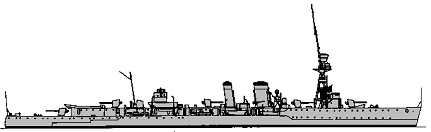
Caledon 1917
Graphics
Calypso 1919
Project history
By late 1915, although 41 light cruisers were in service or nearly complete only 24 were available for the Grand Fleet (5 with the battle squadrons, 12 with destroyers). Accordingly, six 'Improved Centaur' class were ordered in December 1915, incorporating many wartime lessons, including a heavier armament of deck-mounted TT. They could easily be distinguished from the earlier ships by the raked bow. The improvements were mainly to improve seakeeping (a slightly longer forecastle (and to compensate for topweight 0.2m more beam). Like the Centaurs they proved remarkably tough ships. The fifth and sixth ships were held over to form part of the next class, Ceres.
"C" type cruisers were created for service in the North Sea under 1915 year design and become obsolete to the beginning of 1930th, and in 1935 the decision to convert them to AA ships was accepted. Two prototypes were appeared successful and during the period 1936-1940 it was planed rearm 11 "C" type ships. Caledon passed update since September, 1942 till December, 1943.
The arms structure on her significantly differed from earlier conversions: the number of 102mm mounts was cut to three, but number of light AA guns was significantly raised. After conversion of Caledon the program have ultimately ended: there was no sense to spend means for obsolete ships.
Ship protection
Armoured belt protected ship at full length, its thickness was 76mm abreast machinery spaces (51mm armour on 25mm plating), 51mm (38mm armour on 13mm plating) aft and 38mm (25mm armour on 13mm plating) fore. Belt was closed by aft 25mm bulkhead near stern. It extended to main deck (and to upper deck abreast machinery). Machinery and steering gear were covered by 25mm deck.
Modernizations
mid-1918, Caledon, Cassandra: fore flying-off platform and hangar were replaced by turning flying-off platform amidship
1919, all survived: CT was replaced by lighter one with thinner armour.
1920s, all survived: + 2 x 1 - 40/39 2pdr QF Mk II
3/1942, Caradoc: - 2 x 1 - 40/39; + 5 x 1 - 20/70 Oerlikon Mk II/IV, type 286 radar
early 1943, Caradoc: - type 286 radar; + type 271, type 290 radars
(9/1942 - 12.1943, Chatham DYd), Caledon: Full new armament was fitted: 3 x 2 - 102/45 QF Mk XVI, 2 x 2 - 40/56 Bofors Mk IV, type 272, type 279, 2x type 282, type 285 radars. Fore superstructure was reconstructed.
10/1944, Caledon: + 6 x 1 - 40/56 Bofors Mk III, 1 x 1 - 20/70 Oerlikon Mk II/IV. Full displacement rose to 5320t, including 200t of led ballast.
1.1946, Caledon: 3 x 2 - 102/45 Mk XIX, 2 x 2 - 40/60 Mk IV Hazemeyer, 6 x 1 - 40/60 Mk III, 1 x 1 - 20/70 Mk III, type 272, type 279, 2x type 282, type 285 radars
1.1946, Caradoc: 5 x 1 - 152/45 P Mk XIII, 2 x 1 - 76/45 Mk II, 5 x 1 - 20/70 Mk III, 4 x 2 - 533 TT, type 271, type 290 radars
Naval service
Caledon was hit by 305mm shell in Heligoland Bight 17.11.1917. Calypso took part in this action too, when all bridge personnel was killed by a shell. She was sunk by a torpedo from Italian submarine Bagnolini 12.6.1940 near Tobruk. Caradoc stranded on Fair Isle in 15.8.1917 with Cassandra. Cassandra was sunk by Russian mine in Gulf of Finland 5.12.1918.
Many thanks to Wolfgang Stöhr for additional information on this page.