NAVYPEDIA
 Support the project with paypal
 HOME
HOME FIGHTING SHIPS OF THE WORLD
 RUSSIA / USSR
 TORPEDO SHIPS
 LENINGRAD destroyer leaders (project 1) (1936 - 1938)
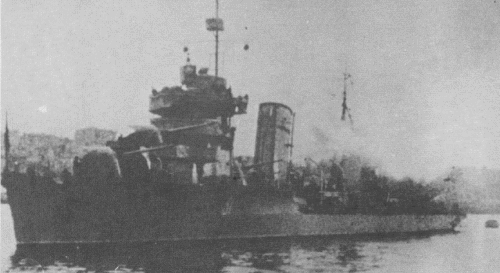
Photo
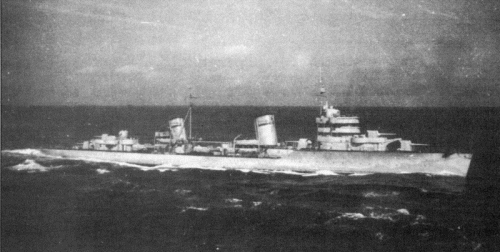
Moskva 1940
Ships
| Name | No | Yard No | Builder | Laid down | Launched | Comp | Fate |
|---|---|---|---|---|---|---|---|
| Ленинград [Leningrad] | 450 | 190 Zhdanov Yd, Leningrad | 11.1932 | 17.11.1933 | 12.1936 | target 4.1958 | |
| Харьков [Kharkov] | 223 | 198 Marti Yd, Nikolayev | 10.1932 | 9.9.1934 | 11.1938 | sunk 6.10.1943 | |
| Москва [Moskva] | 224 | 198 Marti Yd, Nikolayev | 10.1932 | 30.10.1934 | 8.1938 | sunk 26.6.1941 |
Technical data
| Displacement standard, t | 2032 |
|---|---|
| Displacement full, t | 2582 |
| Length, m | 127.5 |
| Breadth, m | 11.7 |
| Draught, m | 4.06 mean 4.18 max |
| No of shafts | 3 |
| Machinery | 3 geared steam turbines sets, 3 water-tube boilers |
| Power, h. p. | 66000 |
| Max speed, kts | 36 |
| Fuel, t | oil 613 |
| Endurance, nm(kts) | 2100(20) |
| Armament | 5 x 1 - 130/50 B-13, 2 x 1 - 76/52 34K, 2 x 1 - 45/43 21K, 4 x 1 - 12.7/79, 2 x 4 - 533 TT, 2 DCR (25), 76 mines |
| Electronic equipment | Mars hydrophone |
| Complement | 250 |
Graphics
Leningrad 1944
Moskva 1940
Project history
First combat ships designed and built in the USSR after a long-term break, called by revolution and civil war. The design assignment of the first Soviet destroyer leader has been approved 1.11.1928 (preliminary works were conducted since 1925). It provided creation of large ship, on armament and speed exceeding as available Noviks, and the majority foreign destroyers. The basic project 1 was approved in February, 1930, and in the end of 1932 under it building of 2 ships for Black Sea Fleet and 1 for Baltic Fleet was begun. Hulls of project 1 leaders differed by considerable slenderness, sharp stern streamlines, and also absence of propeller shafts A-brackets: they were replaced by so-called "trousers". Triple-shaft machinery was placed en echelon in five compartments. It has predetermined a characteristic outline profile with two widely placed funnels and a high fore superstructure. Leaders received new B-13 130mm/50 guns, but their long-term development has delayed commission of ships. Besides, gun No3 was placed unsuccessfully and had limited arcs of fire. Fire control system was Italian by Galileo. 533mm TTs were applied for the first time in the Russian / Soviet Navy. The original design provided seaplane, but later it was refused.
On trials all ships have significantly exceeded a designed speed. Leningrad has shown 43kts at 2225t and 67250hp; Moskva 43.57kts at 2330t and 77725hp. However the insufficient hull strength, crankiness and bad manoevreability on low speed were been revealed. In a result, after formal commission Leningrad spent two years at the shipyard for elimination of defects. Following 3 ships (Minsk, Kiev and Tiflis) were built under improved project 38. The basic differences consisted in more full stern form and application of usual A-brackets for propeller shafts. On the speed they yielded to predecessors, having shown on trials 40-40.7kts.
In January, 1949 Leningrad was re-rated as destroyer.
Modernizations
early 1942, Kharkov: - 2 x 1 - 45/43; + 6 x 1 - 37/63 70K, 4 x 2 - 12.7/90
early 1942, Leningrad: - 2 x 1 - 45/43; + 1 x 2 - 76/52 81K, 4 x 1 - 37/63 70K, 1 x 2 - 37/80 SK C/30, 4 x 1 - 12.7/79
late 1942, Kharkov: + 2 x 1 - 37/63 70K
1944, Leningrad: - 1 x 2 - 37/80; + 2 x 1 - 37/63 70K, type 291, SF radars
1/1946, Leningrad: 5 x 1 - 130/51 B-13, 1 x 2 - 76/55 81K, 2 x 1 - 76/55 34K, 6 x 1 - 37/73 70K, 8 x 1 - 12.7/79, 2 x 4 - 533 TT, 2 DCR (25), 76 mines, type 284 radar
1954, Leningrad: was armed with 5 x 1 - 130/51 B-13, 4 x 2 - 37/70 V-11, 2 x 4 - 533 TT, 2 DCT, 2 DCR (67), 76 mines, Giuys-1, Rif-1, Vympel-2 radars, Tamir-5N sonar; max speed was 34 - 35kts.
Naval service
To the beginning of Great Patriotic War Leningrad served on Baltic, Moskva and Kharkov on Black Sea. Moskva was lost 26.6.1941 on Romanian mines at Constanza. Kharkov was sunk 6.10.1943 by German aircraft S of Yalta (Crimea).