NAVYPEDIA
 Support the project with paypal
 HOME
HOME FIGHTING SHIPS OF THE WORLD
 BELGIUM
 ESCORTS
 ARTEVELDE frigate (1943/1945)
Photo
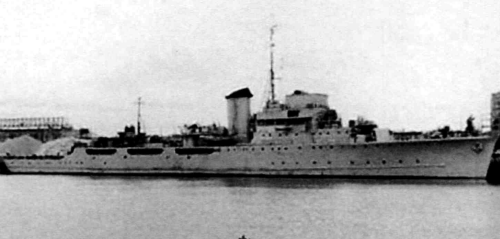
Artevelde
Ships
| Name | No | Yard No | Builder | Laid down | Launched | Comp | Fate |
|---|---|---|---|---|---|---|---|
| Artevelde (ex-K4 Lorelei, ex-Artevelde) | Cockerill, Antwerp / Wilton-Fijenoord, Schiedam, Netherlands | 1939 | 28.8.1940 | 4.1943 // 6.1945 | barrack ship 1951 |
Technical data
| Displacement standard, t | 1640 |
|---|---|
| Displacement full, t | 2306 |
| Length, m | 94.8 wl 98.5 oa |
| Breadth, m | 10.5 |
| Draught, m | 3.3 normal 3.80 deep load |
| No of shafts | 2 |
| Machinery | 2 Parsons-Rateau geared steam turbines sets, 2 Babcock & Wilcox boilers |
| Power, h. p. | 21700 |
| Max speed, kts | 28.5 |
| Fuel, t | oil 680 |
| Endurance, nm(kts) | 1200(19) |
| Armament | 3 x 1 - 105/42 SK C/32, 2 x 1 - 40/56 FlaK 28, 1 x 2 - 37/80 SK C/30, 3 x 4 - 20/65 C/38, 2 x 2 - 20/65 C/38, 120 mines, mechanical minesweeping gear |
| Complement | 180 |
Standard scale images
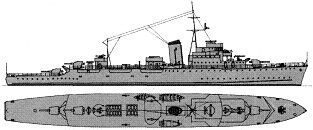
Artevelde 1945
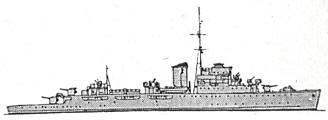
Artevelde 1950
Graphics
Artevelde
Project history
Fishery protection vessel and royal yacht Artevelde, designed for replacement of older Zinnia, could be used also as escort and minelayer. Ship was captured on a slipway in Antwerp, renamed Lorelei and 28.8.1940 renamed again as K4. K4 was launched under German control and towed off to the Netherlands for outfitting, during which time she received German armament (designed armament consisted from 2 twin 105mm guns and 1 twin 40mm AA MG, 30 DCs and 64 mines). Machinery had British origin: Parsons turbine units and Babcock & Wilcox boilers with raised steam parameters (32atm, 400°C). Ship differed as seaworthy and fast, but had no any protection (except 40mm gun shields) and had poor stability. The basic purpose of ship was anti-air defence of convoys. After war K4 was returned to Belgium where served under former name as frigate.
Modernizations
None.
Naval service
Artevelde was returned by Germans with damaged machinery, which was never repaired and used really as stationary training ship, converted to barrack ship in 1951 and broken up 22.11.1954.